
Scale insects rank among the most persistent and challenging pests that plant owners encounter, often going unnoticed until significant damage has already occurred. These tiny, armor-plated insects attach to plants and slowly drain their life, making early identification and swift action crucial for plant health.

Whether you’re dealing with indoor plants showing mysterious yellowing leaves or outdoor trees developing sticky surfaces and black sooty growth, understanding scale insects is essential for any plant enthusiast. This comprehensive guide will equip you with the knowledge to identify, treat, and prevent scale infestations before they compromise your plants’ health.
What Are Scale Insects
Scale insects are small, piercing-sucking pests that feed on plant sap and belong to the superfamily Coccoidea, with approximately 8,000 species worldwide that affect both indoor plants and outdoor vegetation. These specialized insects use long, needle-like mouthparts that extend six to eight times their body length to pierce plant tissues and extract vital fluids.
The characteristic waxy, protective covering that resembles fish or reptile scales gives these pests their common name. This scale covering serves as both protection and camouflage, making them exceptionally difficult to spot during casual plant inspections. Female scales become mostly immobile once they settle and begin feeding, whereas males are rarely observed because they typically die shortly after mating.
Scale insects are among the most difficult plant pests to control because their protective covering shields them from many contact insecticides. Their ability to reproduce rapidly and their inconspicuous nature mean that scale populations can build up significantly before plant owners realize they have an infestation.
Most species are restricted to particular host plants or plant groups, though some scale insects affect a broad range of plant species. They commonly infest both woody plants and indoor plants, making them a concern for gardeners and houseplant enthusiasts alike.
Identifying Scale Insects on Plants
Scale insects appear as barnacle-like or dome-shaped bumps on stems, leaves, and bark, often blending seamlessly with the plant’s natural surface. Their size ranges from pinhead-sized to quarter-inch, depending on the species, with mature scales typically measuring 1/8 to 1/4 inch in length.
Colors range from brown and black to white and yellow, with some species displaying mottling or stripes. Brown soft scale, for example, may appear as mottled, shiny, pale brown, yellow, or grey with dark brown grid-like markings. San Jose scale appears as tiny gray circular bumps about the size of a pinhead with a distinctive yellow central nipple.
These pests are often mistaken for natural plant growths or bark irregularities, especially in their early stages when they’re small and light-colored. Newly settled crawlers appear as tiny bumps that gradually darken and enlarge as they mature, making early detection challenging without close inspection.
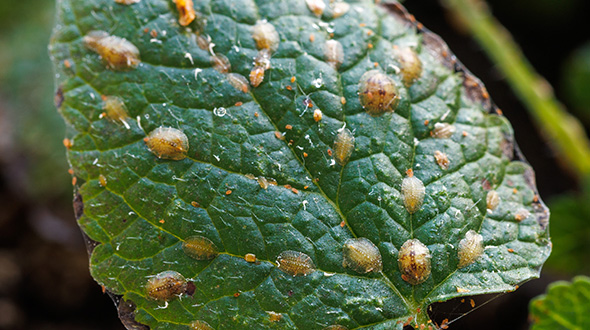
The presence of sticky honeydew and black sooty mold is an important indirect sign of soft scale infestations. Most soft scales produce honeydew, a sweet excretion that makes everything around or under infested plants sticky and attracts ants, bees, wasps, and flies. This honeydew also supports the growth of sooty mold, a black-colored fungus that coats leaf surfaces and interferes with photosynthesis.
Using magnification tools and needle tests can confirm live infestations when visual identification proves difficult. A practical inspection method involves flipping over suspicious bumps with a thumbnail to determine if scale insects are present underneath. Live scales will have soft tissue underneath their covering, while dead scales will be hollow or easily crushed.
Types of Scale Insects
Scale insects fall into several distinct categories, each with unique characteristics that affect identification and control strategies.
Soft Scales
Soft scales represent larger scales with a soft, waxy coating that remains inseparable from the insect body. These scales measure 1/8 to 1/4 inch in length when mature and possess a smooth, cottony, or waxy surface that’s round to oval and dome-shaped.
All soft scales produce honeydew, which leads to sooty mold growth that causes additional plant stress and aesthetic issues. This sticky secretion makes soft-scale infestations relatively easy to identify, as honeydew accumulates on leaves and surfaces beneath infested plants.
Common species include brown soft scale, which attacks a wide variety of hosts and is among the most common on houseplants. Hemispherical scale appears brown, smooth, glossy, and very convex, typically producing two generations per year and showing a strong preference for ferns, asparagus fern, palms, and many non-woody evergreen plants.
Other notable soft-scale species include the cottony cushion scale, which appears white and cottony, and various lecanium scales that commonly infest outdoor ornamental plants. Tuliptree scale and wax scale are additional soft-scale threats, particularly to deciduous fruit trees and woody ornamentals.
Armored Scales
Armored scales differ fundamentally from soft scales in their hard, protective shell or scale covering beneath which the actual insect body lives. These are the smallest scales, and their hard covering can be easily removed to reveal the insect beneath, though doing so will kill the insect.
A key distinguishing feature is that armored scales do not produce honeydew, eliminating the sticky secretion and sooty mold problems associated with soft scales. This makes armored scale infestations more challenging to detect until plant damage becomes apparent.
Armored scales display three main shapes: rounded scales that appear circular, oystershell scales that are elongated and oyster shell shaped, and pupillarial scales that have a distinctive pupal-like appearance. These shapes help with accurate identification and species determination.
Common species include tea scale, San Jose scale, false oleander scale, and obscure scale. Pine needle scale represents a particularly significant armored scale threat, appearing as white, oystershell-shaped scales that can completely cover conifer needles. Euonymus scale commonly attacks euonymus plants, while oystershell scale affects many trees and shrubs.

Specialized Scale Types
Beyond the traditional soft and armored categories, several specialized scale types pose unique identification and control challenges.
Giant scales are the largest-scale species, resembling mealybugs with visible legs and antennae. These scales offer greater mobility than typical scales and are easier to spot due to their size and movement.
Ground pearls affect turfgrass by attaching to roots, making them nearly impossible to detect until the grass begins to yellow and die. These scales create pearl-like cysts around grass roots and can persist for years in soil.
Felt scales, including the crape myrtle bark scale, appear uncommon but distinctive with their white, felt-like covering. These scales typically develop on bark surfaces and can be mistaken for fungal growth or lichen.
Mealybugs, while technically related pests rather than accurate scales, share similar feeding habits and often get grouped with scale insects. They display a white, cottony appearance with waxy filaments and remain mobile throughout their lives, making them easier to spot but also more likely to spread between plants.
Scale Insect Life Cycle
Scale insects typically develop through three main stages: egg, nymph (crawler), and adult, with the crawler stage representing the most vulnerable period for control interventions.
Female scales lay eggs under their protective covering or in waxy ovisacs, depending on the species. Soft scales, such as the hemispherical scale and the brown soft scale, typically lay eggs beneath their body covering, whereas some species form separate egg masses. The number of eggs varies by species, with some laying dozens and others laying hundreds.
The crawler stage consists of mobile nymphs that disperse to new feeding sites after eggs hatch. These tiny, flat, pink or yellow crawlers lack the protective covering of adult scales and actively search for suitable feeding locations. Crawlers represent the primary dispersal stage, as they can be carried by wind, animals, or contaminated tools to new plants.
Settlement and development of protective covering occur after the first molt, when crawlers insert their mouthparts into plant tissue and begin producing their characteristic scale covering. Once settled, female scales become largely immobile and focus on feeding and reproduction.

The timing of crawler emergence varies significantly by scale species and season—pine needle scale eggs hatch in mid-May into tiny crawlers, with two generations produced each year. Brown soft scale and hemispherical scale typically produce two generations per year, whereas some species produce only one.
Multiple generations per year are possible, especially for indoor plants where temperature and humidity remain relatively constant. This continuous reproduction cycle means that all life stages may be present simultaneously on heavily infested plants, complicating control efforts and requiring sustained treatment approaches.
Understanding crawler emergence timing is crucial for effective treatment, as most contact insecticides are most effective when applied during the vulnerable crawler stage. Regular monitoring helps identify when crawlers emerge, allowing for precisely timed control applications.
Damage Caused by Scale Insects
Scale insects damage plants by directly removing sap, causing gradual yellowing, wilting, and stunted growth as they deprive them of vital nutrients and water. Unlike many other plant pests that cause immediate, dramatic damage, scale insects typically cause gradual plant decline over several years rather than immediate death.
The feeding process involves piercing plant tissues with their specialized mouthparts and continuously extracting plant sap. This constant drain on plant resources leads to reduced vigor, yellowing leaves, and stunted growth patterns. Heavy scale infestations can cause yellowed leaves, distorted foliage, especially at the growing tips, twig dieback, or complete defoliation.
Branch dieback and premature leaf drop occur in severe infestations, particularly when scale populations build up over multiple seasons. Pine needle scale, for example, can cause needle yellowing and even branch death on heavily infested conifers. The cumulative effect of numerous scales feeding on the same plant can overwhelm the plant’s ability to maintain normal growth.
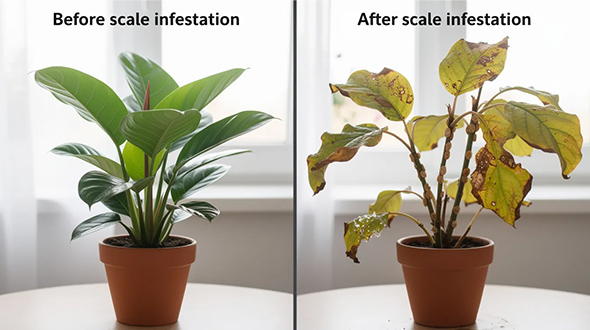
Honeydew production by soft scales leads to sticky surfaces and black, sooty mold growth, which creates additional plant stress beyond direct feeding damage. The sticky honeydew makes everything around or under infested plants unpleasant to touch and attracts various insects, including ants, bees, wasps, and flies.
Sooty mold grows on the sweet honeydew and blackens leaf surfaces, interfering with photosynthesis and making plants unattractive. This fungal growth can coat entire plant surfaces in severe infestations, further reducing the plant’s ability to produce energy through photosynthesis.
Reduced plant vigor makes plants more susceptible to secondary pest infestations, disease, and environmental stress. Weakened plants become more vulnerable to drought, temperature extremes, and other plant pathogens.
Scale damage is often mistaken for watering or fertilization issues because the gradual yellowing and decline mimic nutrient deficiencies or water stress. This confusion can delay proper diagnosis and treatment, allowing scale populations to continue to grow while plant owners pursue inappropriate solutions.
Signs of Scale Infestation
Early detection requires systematic visual inspection of stems, leaf undersides, and bark crevices where scales typically establish feeding sites. Focus inspection efforts on areas where leaves attach to stems, as these protected locations provide ideal settling sites for crawlers.
Look for small, waxy bumps that may vary in color from brown and black to white and yellow. Young scales often appear light-colored and gradually darken as they mature, so check for bumps of various sizes and colors. Pay particular attention to new growth areas, as many scale species prefer tender plant tissues.
Early warning signs include slight yellowing and reduced growth that may initially appear minor but gradually worsen over time. Plants may show reduced vigor, smaller leaves, or slower growth rates before obvious scale insects become visible. These subtle changes often precede visible-scale population changes by weeks or months.
Advanced symptoms include heavy honeydew production, black sooty mold growth, and branch dieback, which indicate well-established infestations. Sticky surfaces beneath plants, ant activity around plants, and black fungal growth on leaves all suggest advanced soft-scale problems requiring immediate intervention.
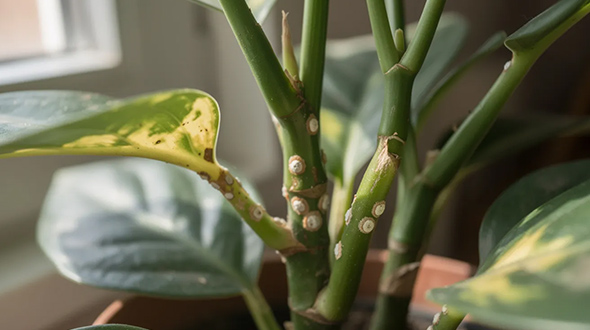
Seasonal monitoring times when scales are most visible vary by species and location. Spring emergence of crawlers makes scales easier to spot, as the mobile crawlers appear as tiny moving specks on plant surfaces. Late spring and early summer often provide the best detection opportunities for many species.
Using photography tools and magnification aids in early detection by allowing closer examination of suspicious plant areas. Smartphone cameras with macro capabilities can help document suspected infestations and track changes over time. Hand lenses or magnifying glasses reveal details that help distinguish scales from natural plant structures.
Regular inspection routines should focus on plants known to be susceptible to scale insects, including ferns, palms, citrus, and many woody ornamental plants. Monthly inspections during growing seasons help detect infestations early, when control options are most effective.
Control Methods for Scale Insects
Cultural and Physical Control
Hand removal of scales with fingernails or a soft brush provides immediate reduction for light infestations, particularly effective on indoor plants where individual scales are easily accessible. This mechanical removal works best on soft scales, which can be scraped off with minimal plant damage.
Pressure washing with consumer-grade equipment can achieve up to 70% reduction in scale populations when properly applied. Direct the water stream at affected plant areas, focusing on the undersides of leaves and stem junctions where scales typically congregate. This method works particularly well for outdoor plants and can dislodge both scales and their eggs.
Proper plant spacing and air circulation help reduce humidity levels that favor scale development. Crowded plants create microclimates with higher humidity that promote scale reproduction and survival. Adequate spacing also improves inspection access and treatment coverage.
Regular plant inspection and monitoring routines enable early detection when control options remain most effective. Establish weekly inspection schedules during the growing season, focusing on known-susceptible plant species and previously infested areas.
Plant replacement with non-susceptible plant species may be necessary after professional identification confirms repeated treatment failures. Some plants show inherent resistance to specific scale species, making replacement a long-term solution for persistently problematic areas.
Biological Control
Natural enemies, including parasitoid wasps, lady beetles, lacewings, and predatory mites, provide ongoing scale control when properly supported through integrated pest management approaches. These beneficial insects attack scale insects during various life stages, providing sustainable control without chemical inputs.
Parasitoid wasps lay eggs inside scale insects, with developing wasp larvae eventually killing their hosts. Signs of parasitism include small emergence holes in scale covers, indicating successful biological control activity. Multiple wasp species attack different scale species, providing broad biological control potential.
Lady beetles, particularly the twice-stabbed lady beetle, specialize in scale insect predation and can significantly reduce scale populations when present in adequate numbers. Both adult beetles and their larvae actively hunt and consume scales throughout their development.
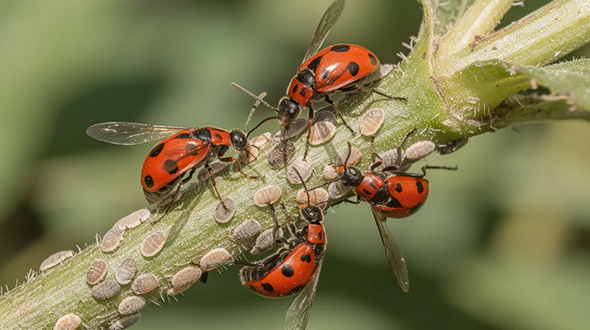
Maintaining beneficial insect populations requires reducing pesticide use and providing alternative food sources during periods when scale insects are scarce. Broad-spectrum insecticides eliminate beneficial insects along with pest species, often leading to scale population rebounds.
Fungal pathogens naturally suppress scale populations under favorable environmental conditions, particularly during periods of high humidity and moderate temperatures. These naturally occurring diseases can cause significant scale mortality without human intervention.
Chemical Control Options
Horticultural oils, including both dormant oil applications during plant dormancy and growing season treatments, suffocate scale insects by blocking their breathing pores. These oils work effectively against all scale life stages and provide excellent control when properly timed and applied.
Dormant oils applied during late winter or early spring target overwintering scales before crawler emergence. These heavy oil applications penetrate scale coverings more effectively when plants are dormant, and temperatures remain cool. Apply dormant oils when temperatures are expected to stay above freezing for 24 hours after application.
Growing-season oil applications use lighter formulations that won’t damage active foliage while still providing effective scale control. These oils require thorough coverage and are most effective when applied during crawler emergence, when young scales lack protective coverings.
Insecticidal soap targets crawlers and soft-bodied scale stages effectively while remaining relatively safe for beneficial insects. Soap products work by disrupting scale cell membranes and require direct contact for effectiveness. Multiple applications at weekly intervals may be necessary to catch emerging crawlers.
Systemic insecticides, particularly neonicotinoids, provide long-term scale control by being absorbed into plant tissues and affecting scale insects when they feed. These products are effective against established infestations but may take several weeks to reach full effectiveness.
Products containing imidacloprid control soft scales and certain other scale species, but are ineffective against armored scales or the cottony cushion scale. Understanding these limitations helps select appropriate products for specific scale problems.
Insect growth regulators containing pyriproxyfen target the crawler stage by preventing normal development and reproduction. These products stop crawlers from maturing into reproductive adults and reduce egg production in treated scales.
Contact insecticides require precise timing relative to crawler emergence for maximum effectiveness, as mature scales remain protected beneath their coverings. Monitor for crawler activity and apply contact sprays during peak emergence periods for best results.
Prevention Strategies
Quarantine procedures for new plants entering homes or gardens prevent the introduction of scale insects from contaminated plant sources. Inspect all new plants carefully and isolate them for several weeks before placing them near established plant collections.
During quarantine periods, monitor new plants closely for any signs of scale development. Many scale infestations come from newly purchased plants that appeared healthy at the time of purchase but carried eggs or young scales that weren’t immediately visible.
Regular plant health monitoring and early intervention prevent minor scale problems from developing into severe infestations. Establish routine inspection schedules and respond quickly to any suspicious plant changes or visible scales.
Avoiding plant stress through proper watering and fertilization maintains plant vigor and resistance to scale establishment. Stressed plants become more susceptible to scale infestations and suffer greater damage when scales establish.
Water plants appropriately for their species and environmental conditions, avoiding both drought stress and overwatering. Maintain proper fertilization programs without over-fertilizing, which can promote soft, succulent growth that attracts scales.

Selecting resistant plant varieties when available provides long-term scale prevention for new plantings. Some plant cultivars show natural resistance to specific scale species, though complete immunity remains rare.
Research plant selections for known scale susceptibility before purchasing, especially for areas with a history of scale problems. Extension service publications often provide information on plant resistance and susceptibility to local-scale species.
Maintaining clean gardening tools prevents scale dispersal between plants and garden areas. Disinfect pruning tools between plants, especially when working on known-susceptible species or in previously infested areas.
Understanding scale-dispersal methods helps prevent accidental spread via wind, animals, and contaminated tools. Crawlers can be carried considerable distances by wind currents, while birds and other animals can transport scales between plants on their bodies.
When to Seek Professional Help
Extensive infestations covering multiple plants or large trees often exceed the capability of homeowner treatment methods and require professional expertise and equipment. Professional applicators have access to more effective products and application techniques that aren’t available to consumers.
Large trees infested with scales may require specialized equipment to ensure proper treatment coverage, including hydraulic sprayers and boom trucks capable of reaching entire tree canopies. Professional arborists understand proper timing and techniques for treating different-scale species across various tree species.
Difficulty identifying scale species for targeted treatment suggests the need for professional diagnosis and treatment recommendations. Accurate identification determines appropriate control strategies, as different scale species respond differently to various treatment approaches.
Professional entomologists and extension specialists can provide species identification services through submitted samples, often available through county extension offices or university diagnostic laboratories. Proper identification ensures that selected control methods will be effective against the specific scale species present.
Repeated treatment failures with home remedies indicate the need for professional assessment and intervention. Persistent scale problems may result from incorrect species identification, improper treatment timing, or ineffective products.
High-value ornamental plants requiring specialized care benefit from professional treatment that minimizes plant stress while maximizing scale control effectiveness. Mature landscape trees, rare plants, or valuable ornamental specimens justify professional treatment costs through plant preservation.
Professional treatment options often include systemic insecticides that require specialized application techniques and licensing for use. These products may provide longer-lasting control than consumer products but require professional expertise for safe and practical application.
County extension offices provide local expertise and can recommend certified arborists or pest control professionals experienced with scale insects. Extension agents understand local-scale species and can provide region-specific control recommendations.
Contact information for certified arborists is available through professional organizations like the International Society of Arboriculture, which maintains directories of certified professionals. Look for arborists with specific experience in scale insect management and integrated pest management approaches.
Professional pest control companies specializing in ornamental plant care offer ongoing monitoring and treatment services that maintain scale control over multiple seasons. These services often prove more cost-effective than repeated individual treatments for severe or recurring infestations.
Scale insects on plants present complex identification and control challenges that require patience, persistence, and often professional expertise. Early detection and prompt intervention remain the keys to successful scale management, whether dealing with indoor plants or extensive outdoor landscapes. By understanding the various scale types, their life cycles, and appropriate control methods, plant owners can develop effective strategies for maintaining healthy, scale-free plants throughout the growing season.
(678) 505-0266
Originally published on: https://www.toddsmariettatreeservices.com/scale-insects-on-plants/

No comments:
Post a Comment