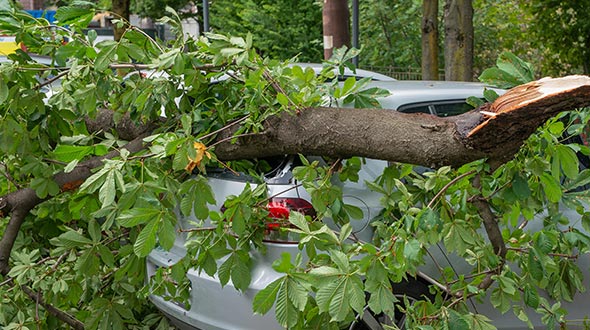
Prevent your dying maple tree from becoming an extreme hazard to your property and wellbeing. By knowing what to do when your maple is in decline, you can save it from an otherwise early death.
toddsmariettatreeservices.com gathered information on how to identify when a maple tree is in decline, what is causing it to decline, and how you can nurse it back to health.
Maple Tree Diseases, Problems, and Solutions
To save a dying maple tree, it helps if you know why the tree is dying. When inspecting a dying maple tree, consider the following symptoms, their meaning, and what to do:
Chlorosis of Maple Tree Foliage

Your tree’s leaves should remain vibrant green (or red depending on the species) until the beginning of the fall season (when cooler weather sets in). If they are losing their color prematurely, this may be a symptom of:
- Poor soil drainage
- Compacted soil
- Poor root growth
- Damaged roots
- High soil alkalinity
- Nutrient deficiencies in the tree
Treatment for chlorosis varies depending on the cause. Consider the following measures to reverse this condition in the next growing season:
- Poor soil drainage requires the introduction of mixed layers of soil, the Installation of subsurface tile drains (sections of perforated pipe buried 12 to 18 inches below the soil surface), or working large quantities of organic material into the soil surrounding your tree.
Note: Take extra precautions to preserve tree roots when tilling or aerating soil within your tree’s root plate.
- Compacted soil and poor root growth generally occur hand-in-hand. You can reverse soil compaction by working large quantities of organic material into the soil surrounding your tree. Once the organic material has been worked into the soil, keep the entire root plate covered with a 3 to 6-inch layer of organic mulch.
Tip: The addition of earthworms will significantly speed up this process. They will draw organic material into the soil as they tunnel through it.
- Damaged roots can present a challenge as they are a gateway for a disease to quickly infect and severely compromise the health of your maple tree. Damaged roots from digging or lawnmower activity should be cleaned and treated with tree paint or pruning sealer.
- High soil alkalinity and nutrient deficiencies in the tree can be corrected by adjusting the soil pH and soil enrichment with organic material. The ideal soil pH range for maple trees is between 5.5 and 7.3. It can be lowered by using organic mulch, which coincidentally, will provide nutrients to your tree.
Water Sprouts and Tree Suckers

Water sprouts are a tree’s attempt to grow more branches, often after injury. If the tree is in decline or roots have been damaged, suckers may grow from the roots or base of the trunk. When suckers grow higher on the trunk, they’re referred to as water sprouts and usually appear at the site of a pruning wound, a crack, or some other damage.
Water sprouts and tree suckers deprive a tree of essential nutrients and energy. Even though this is typically an emergency response by the tree to heal or survive, they do more harm than good.
After removing water sprouts and tree suckers, address the injuries or deficiencies that prompted their growth.
Mushrooms on Your Maple Tree

If mushrooms are growing on your maple tree’s trunk or roots, you may have a severe problem. The presence of mushrooms and mushroom conks is a sign that the pulp of your tree is rotting. The fungi that produce mushrooms (the fruiting body of the fungus) flourish when fed by decaying organic material.
- Prune and dispose of branches with mushrooms growing on them.
- Have the tree treated or removed by a professional tree service when mushroom growth is located anywhere on the trunk or roots.
- Sanitize all equipment used on infected trees with a 1cup of bleach to 1gallon of water solution to prevent the spread of disease to other trees and plants.
Tip: As millions of spores can be produced and released by a single fruiting body, it is recommended to call a professional tree service to remove and dispose of them.
Read more about the significance of mushrooms growing on a tree at toddsmariettatreeservices.com/mushrooms-on-trunk-means-your-tree-dying/
Splitting Tree Bark
Tree bark splits or cracks for several reasons, and you cannot simply fix it. However, you can protect your tree while it compartmentalizes the damage and protect it from further damage by taking preventative measures.
While bark splitting is a common occurrence on younger trees, all trees are susceptible to bark splitting when exposed to the following conditions:
- Sunscald (Southwest Winter Injury)
- Frost Cracks
- Environmental Conditions (Drought)
- Herbicides (Glyphosate Products)
Bark splitting may also be caused by the swelling of the trunk or branch when infected by a rapidly reproducing pathogen.
As split bark presents an opportunity for successful attacks by disease or insects, call on the expertise of a professional tree service to assist you in protecting your maple tree as it compartmentalizes the damage.
Read more about the causes and treatment of splitting bark at toddsmariettatreeservices.com/tree-bark-splitting-can-i-fix-it/
My Tree Is Leaning
When your mature tree can no longer hold itself to the land or has broken away from its roots, it may lean before suddenly falling. This is a tree emergency and should be immediately removed by a professional tree service.
Younger, lighter trees can be cabled or staked in an attempt to stabilize them. This process may require several growing seasons before the tree’s root plate can successfully re-establish itself.
During this recovery time, the reason(s) for the tree’s destabilization should be diagnosed and corrected to avoid future occurrences.
Dieback
A sure sign that your tree is in distress is when branches begin to lose foliage, become brittle, and die. This often occurs when the branches in question are diseased or infested (these branches should be pruned from the tree).

However, when this condition is widespread throughout the canopy, it is referred to as dieback. Dieback occurs when:
- A pathogen is disrupting the tree’s hydraulic system
- Boring insects have consumed sufficient xylem or phloem to impede the back and forth flow of water and nutrients from the tree’s foliage to its roots
- The tree is suffering from severe drought conditions
- The tree is partially or entirely girdled
Unfortunately, by the time a tree shows signs of dieback, it may be too late to save it. However, the following may help it partially or wholly recover over several growing seasons:
- Promote the tree’s health by watering, fertilizing, pruning, and mulching it.
- Have the tree inspected and treated for boring insects and/or disease by a professional tree service
- Increase watering frequency during drought conditions
- Remove any roots, ropes, fencing, or vines that are circling the tree, restricting its water and nutrient flow
When treating a tree, keep in mind that as a tree’s health declines, it becomes vulnerable to secondary attacks by insects, pathogens, and even weather conditions. Always be on the lookout for multiple symptoms when diagnosing your maple tree’s problems.
My Tree Is Self-Pruning (Cladoptosis)
While maple trees are among those species that have a tendency to self-prune, consider the following causes when diagnosing your tree:
- A branch has become too shaded and can no longer sufficiently photosynthesize
- Poor pruning practices have left the canopy too dense, obstructing light from reaching inner branches
- Disease has debilitated the branch leading to its decline or hydraulic failure
- The branch is infested, triggering self-pruning as the tree’s defensive measure
- Climbing vines are blocking enough sunlight in the canopy to trigger cladoptosis
Cladoptosis occurs when there is a problem with your tree. If you are unable to detect the primary cause, get a professional tree service to help you before a falling branch causes catastrophic damage.

Saving a Dying Maple Tree
In this article, you discovered several of the conditions your maple tree may be dying from, and how to resolve them to save your tree.
By knowing what to look for, how to quickly treat your tree problems, and when to seek help, you can add countless years to its lifespan.
When you ignore or neglect to treat the often subtle signs of distress your tree displays, you may be sentencing it to certain death.
Sources:
web.extension.illinois.edu/focus/index.cfm?problem=chlorosis
ipm.illinois.edu/diseases/series600/rpd641/
canr.msu.edu/news/what_to_do_about_compacted_soil
extension.umd.edu/hgic/topics/water-sprouts
plantclinic.tamu.edu/2013/11/15/cladoptosis-an-interesting-phenomenon/
(678) 505-0266
Originally published on: http://www.toddsmariettatreeservices.com/how-to-save-a-dying-maple-tree/