Showing posts with label Tree Care. Show all posts

Monday, November 23, 2020

Christmas Tree Care

Trimming the bottom branches of a live Christmas tree

Prevent your live Christmas tree from becoming hazardous or catching fire as it dries out. Knowing how to keep your cut Christmas tree fresh through the holidays will keep your home cheery and holiday spirit safe.

toddsmariettatreeservices.com gathered information on how to select, care for, set up, and eventually dispose of your live Christmas tree.

Fresh Christmas Trees

The first measure of care for your live Christmas tree is selecting a fresh, vibrant tree. Consider the following when looking for the perfect tree:
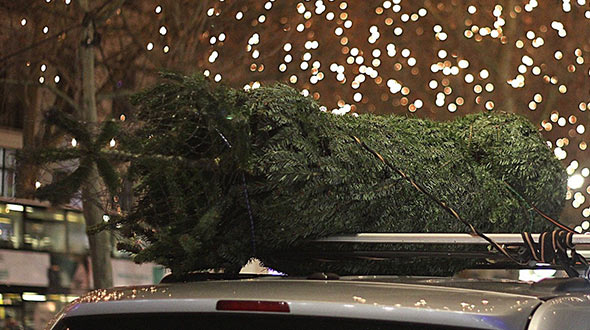
Christmas tree selection and transportation
  • The tree’s needles must be fresh and resilient. Gently hold one of the branches about six inches in from the tip. Then, between your forefinger and thumb, pull your hand in so the branch slides between your fingers. Needles shouldn’t snap or fall off the tree. If they do, move on to the next one.
  • Lift the tree and lightly bounce it on the ground to ensure needles are firmly attached all around the tree. Check for any needles falling off. A tree is considered fresh if only a couple of needles come off after being bounced.
  • The tree should have a vibrant green color and a pleasant fragrance to it.
  • Fresh trees have more moisture and are therefore more fragrant with firmer needles, provided they are kept cool, out of the sun, and in stands with fresh water.
  • Limbs of the tree should be sturdy enough to hold your decorations and lights.

Note: Even if you cut down your own tree, you should take the time to verify its freshness and resilience before making the cut. Drought, disease, and infestation can cause a pine tree to dry out or become brittle.

Tip: When you search for the perfect tree, take along one or two of your heaviest ornaments. Hang them on a limb to “measure” the limbs’ sturdiness.

Ornaments to test a Christmas tree strength

How to Keep a Christmas Tree Alive

Before taking your tree indoors, you can give it the best possible chance of surviving the holiday season by addressing the following:

Tree Location – Go to the intended location of the tree and make sure that:

  • The tree will not be near any heat sources (fireplace, televisions, radiator, etc.)
  • There are no heating/AC vents directed at the location
  • There is enough space so the tree can stand without touching any surrounding walls
  • The location has “low to no” traffic
  • The tree will be in a cool and shaded location
  • Outlets can be easily reached

Note: In smaller homes with limited space, select a smaller live tree or use an artificial tree.

Tree Preparation – Before taking your tree indoors, there are three things to do:

  1. Vigorously shake or bounce the tree to remove any loose needles
  2. Cut a 1/2” disc from the bottom of the tree trunk
  3. Attach the tree stand with a water reservoir (minimum 1-quart capacity)

Tip: The tree trunk base should be submerged in water as quickly as possible after being cut. Waiting too long may result in the tree naturally “sealing” the wound, preventing it from taking up water.

Tree Watering – There are multiple myths and numerous concoctions regarding what a tree needs to stay fresh. However, if you have prepared the tree’s location and freshly cut the trunk base, plain tap water will help the tree stay fresh and vibrant. Consider the following:

  1. The reservoir of your tree stand should hold at least a gallon of water
  2. The tree must “drink.” If it is not taking up water, cut another 1/2” disk from the trunk and immediately return it to the water
  3. On the first day, the tree will likely consume one gallon or more of water
  4. Your tree will then consume around a pint of water per day (check it daily)
  5. Avoid using any additives to the water (plain water is adequate)
  6. Do not let the tree run out of water
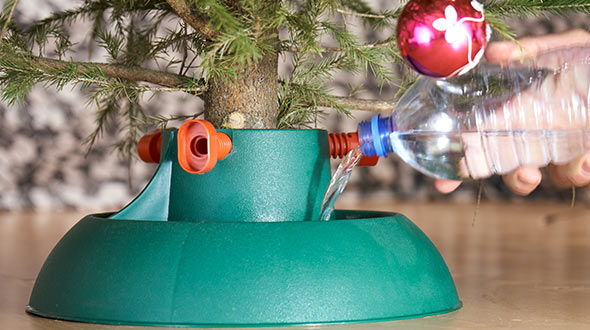
Watering a Christmas tree to keep it fresh and vibrant

Water is essential, as it prevents the tree from drying out, needles from dropping off, and the boughs from drooping. Water is also the key to keeping your tree fragrant through the season.

Tip: Before leaving the tree lot or nursery where you bought the tree, make sure they will replace the tree if it does not take up water.

Lighting a Christmas Tree

How you decide to light your tree may have a tremendous influence on its ability to retain moisture and stay fresh.

Over the past few decades, tree lights have gotten smaller, more numerous, and safer. It is highly discouraged to use traditional incandescent bulbs (with a wire filament) on live trees as they heat up, accelerating the drying process.

LED (Light Emitting Diodes) Christmas tree lighting has surged in popularity for their durability and energy efficiency. These lights don’t have filaments, so they produce considerably less heat than traditional incandescent lights.

Christmas tree led lights to prevent fast drying

Read More about lighting your Christmas tree at toddsmariettatreeservices.com/choosing-lighting-christmas-tree/

Christmas Tree Disposal

When you’re finished with your tree or it has dried out, you have multiple options. Consider the following ways of disposal:

  • Start a new compost pile
  • Take it to a recycling center
  • Chip and use it as mulch
  • Submerse the tree in a pond
  • Ask your municipality if they offer pickup and disposal options
Dried out Christmas tree ready for disposal

Tip: Once you’ve removed the tree from your home, getting up all of those fallen needles may pose a challenge. Avoid frustration by using your vacuum’s hose (no attachment needed) to quickly draw up the needles.

Note: When pine trees are chipped and used as mulch, they lower the soil’s pH, making it more acidic.

How to Keep a Christmas Tree Alive

In this article, you discovered valuable information about selecting, caring for, setting up, and disposing of your live, fresh-cut tree.

When you invest the time to properly care for your live Christmas tree, you give it the means to stay fresh and vibrant throughout the holidays.

Not caring for your Christmas tree can result in the tree’s accelerated dying and drying, creating an extreme fire hazard potentially ending in catastrophic fire damage to your home.

Sources:
web.extension.illinois.edu/trees/selection.cfm
sdda.sd.gov/legacydocs/Forestry/educational-information/PDF/Care-Real-Christmas-Tree.pdf
extension.purdue.edu/extmedia/fnr/fnr-423-w.pdf
mncta.com/tree-care
goodhousekeeping.com/holidays/christmas-ideas/a24803/tips-to-keep-a-christmas-tree-fresh/

Todd’s Marietta Tree Services

200 Cobb Pkwy N Ste 428 Marietta, GA 30062
(678) 505-0266

Originally published on: http://www.toddsmariettatreeservices.com/christmas-tree-care/

Tuesday, June 23, 2020

Self-Pruning Trees (Cladoptosis)

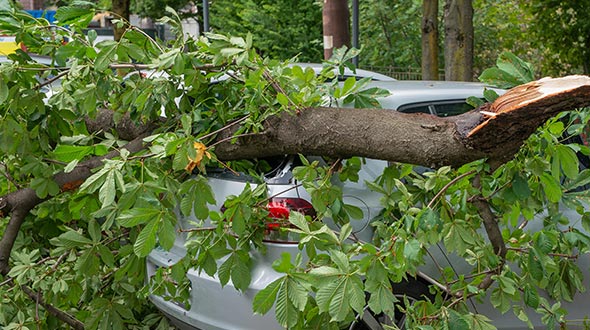
Cladoptosis or self pruning trees can cause the sudden drop of limbs on structures and vehicles

Avoid catastrophic property damage or serious injury when your tree sporadically drops a branch. By knowing why and how this happens, you can take the preemptive steps to stop it from disrupting your life and property.

toddsmariettatreeservices.com defines what self-pruning is, how it happens, why it happens, and which tree species are more likely to do it.

What is Self-Pruning

Self-pruning or cladoptosis is a compartmentalization process involving the shedding of shaded, diseased, or infested branches that have become a drain or a burden on a tree’s resources.

Further defined, this is nature’s way of letting a tree determine which branches need to go, rather than an arborist or a property owner making the decision for it.

Note: On wooded land, self-pruning is a common occurrence, especially in densely populated stands where there is not sufficient sunlight for trees to keep all of their branches. Branches low on tree trunks will likely die from shading and competition, occurring over several growing seasons.

How Self-Pruning Happens

Self-pruning occurs the same way fall foliage, shoots, and twigs are shed from a deciduous tree. As it does with leaves, ripe fruit, flowers, and seeds, a tree will form an abscission layer where the branch connects to the trunk (at the branch collar) and shed the branch cleanly.

Why Self-Pruning Happens

Several reasons can cause a tree to self-prune. Consider the following possibilities:

  • A branch is too shaded and cannot sufficiently photosynthesize
  • Poor pruning has left the canopy too dense, obstructing light from its reaching inner branches
  • Disease has infected the branch causing its decline or hydraulic failure
  • The branch has become infested, triggering self-pruning as the tree’s defensive measure
  • Climbing vines have blocked sufficient sunlight in the canopy to trigger cladoptosis
Cladoptosis or self pruning trees can suffer stress from climbing vines that create conditions for a tree to shed limbs

Self-pruning is more prevalent in dense forests, orchards, more mature trees, and landscape areas that have been over-planted.

Basically, when a tree branch cannot sufficiently photosynthesize (due to a lack of sunlight) or has triggered an infection or infestation response, the tree can spring into action and self-prune the branch.

Regarding shaded branches, how long one survives will vary among tree species and its degree of shade tolerance. Shade tolerance relates to the capacity of a tree species to compete and thrive under shaded conditions. Shade-tolerant species like American beech and eastern hemlock are More proficient at balancing photosynthesis and respiration when growing with severely limited light.

Cladoptosis or self pruning beech trees shed branches when they no longer provide photosynthesis or nutrients to support the limb

Sometimes, the death of a branch does not necessarily ensure its shedding. Although the tree shuts the branch off from water and nutrients, depending on the species, it won’t sever it. In these cases, the tree enlists outside help. These dead branches persist until further weakened by fungi, insects, animals, wind, snow, ice, or gradual decay. At some point, the branch will weaken and fall from its own weight.

Note: In well-kept yards and landscapes, dead, dying, and diseased branches are usually pruned away before cladoptosis can take place.

Trees That Self-Prune

Self-pruning is more prevalent in the fall, and as your trees age, they are more likely to shed more limbs. The following species are known to self-prune, and can do it without warning:

  • Ashes
  • Aspen
  • Birch
  • Cherries
  • Cypress
  • Elms
  • Eucalyptus
  • Larches
  • Maples
  • Oaks
  • Pecans
  • Pines
  • Poplars
  • Walnut
  • Willow
Cladoptosis or self pruning trees aspens shed branches leaving black spots resembling eyes

While it is good practice to remove limbs that grow over your home or other structures, it is necessary to remove them if you have a tree species known to self-prune.

How To Prevent Trees from Self-Pruning

Even with the best care and attention to the needs of your tree, you may not be entirely successful at preventing it from self-pruning. However, the following will help you slow this natural process:

Tree Health – From the time your tree is planted, you should provide it with:

  • Water (two to three waterings per week and more often during drought conditions)
  • Soil (test frequently to adjust nutrient levels and soil pH)
  • Mulch (to protect the root plate and regulate soil temperature); click here to learn more about mulching
  • Prune (to encourage healthy growth and remove unwanted/unneeded growth)
  • Inspect (annual inspections by a professional tree service can help detect issues before they develop)

Tip: When selecting a tree species for your yard or landscape, choose a species that is appropriate for your region’s climate and not prone to self-pruning.

Cladoptosis

In this article, you discovered the definition of self-pruning trees, how the process happens, what causes it, and the species most likely to do it.

By taking steps to increase the health of your tree and the sunlight it receives, you can avoid being taken by surprise when your tree suddenly drops a branch.

Allowing your tree to grow without proper care and attention can lead to it self-pruning unannounced, suddenly dropping branches, causing catastrophic damages to anything or anyone below.

Sources:
northernwoodlands.org/articles/article/woods-whys-self-pruning-branches
cals.arizona.edu/yavapai/anr/hort/byg/archive/pruningshadetrees.html
plantclinic.tamu.edu/2013/11/15/cladoptosis-an-interesting-phenomenon/
warnell.uga.edu/sites/default/files/publications/Tree%20Anatomy%20Defining%20Twigs_14-21.pdf

Todd’s Marietta Tree Services

200 Cobb Pkwy N Ste 428 Marietta, GA 30062
(678) 505-0266

Originally published on: http://www.toddsmariettatreeservices.com/self-pruning-trees-cladoptosis/

Wednesday, October 23, 2019

Why Do I Need a Tree Hazard Assessment

Hazard assessment to prevent tree damage or failure during severe weather

Don’t let your trees threaten your property or life as they destabilize during severe weather. Regular tree assessments and preventative measures can help your trees survive severe storm conditions intact.

toddsmariettatreeservices.com gathered information on why trees need regular hazard assessments, what is examined during an evaluation, the types of damages trees suffer in different storms, and preventative measures you can take.

Tree Hazard Assessments – Emergency and Storm Safety

Tree hazard (or tree risk) assessments provide crucial information to the surveyor and the homeowner about the health and stability of the trees being surveyed. These assessments are used in determining:

• The overall health and stability of a tree
• Whether a tree will remain stable during severe weather events
• If the tree poses an infestation or disease threat to surrounding trees
• If the tree is a threat to surrounding structures or people
• A course of action including pruning or removal

The older your trees become, the more they require hazard assessments. As trees age, they become more massive, less flexible, and in many cases, more susceptible to disease and infestations.

Just as necessary is the assessment of the soil where the tree is rooted, soil erosion can become a significant problem for a tree’s stability. This erosion can cause the root plate to lift during the slightest of winds resulting in an emergency, and the toppling of an otherwise healthy tree.

Without these assessments, your trees can develop irreversible damages from diseases, infestations, girdling, compacted soil, and many other conditions (detected in an assessment) that weaken the tree. All it takes is one severe storm to bring down a weakened tree and cause catastrophic damages.

Follow the link for signs and symptoms of a troubled tree toddsmariettatreeservices.com/troubled-tree-signs-symptoms/

Hazard assessment for diseased or dying trees

What is a Tree Hazard Assessment?

Tree hazard assessments happen when a tree professional or certified arborist physically survey the overall health and stability of a tree. A typical assessment looks for the following:

• Signs of disease
• Signs of infestation
• Abnormal growth habits
• Leaning
• Dead, missing, or damaged bark
• Cracks
• Lightning damage
• Balance and density of the crown
• Dead twigs or branches
• Mushroom conks
• Cankers

These examinations are comprehensive and include assessments of:

• Cut or damaged surface roots
• Lifting of the root plate
• Soil conditions and/or erosion
• Soil compaction
• Pavement over roots
• Topography
• Surrounding structures (targets)
• Typical weather for the location
• Wind exposure
• Vines and other potentially harmful plant species

When a tree professional or arborist performs a tree hazard assessment, he is looking for anything about the tree, its root plate, or environment that could be alarming. Read toddsmariettatreeservices.com/how-to-identify-tree-emergency/ for some warning signs and things to look for that indicate a potential tree emergency, and call an arborist or professional tree service if you suspect something is wrong.

Disaster Tree Damage Caused by Storms

Tree hazard assessments take into account the weather patterns common to the tree’s location. Different elements of weather impact trees differently and may require specific actions to prevent irreversible damages to the tree. The following are some of the weather conditions that can cause a weakened tree to topple and preventative measures:

Tree hazard assessment to prevent property damage during storms

Wind – When wind speeds are high, they can impose tremendous force on a tree. During hurricanes or tornadoes, trees may be stripped of their leaves and branches. These winds are capable of twisting, breaking, and uprooting trees. Also, during major storms, debris may debark the tree requiring its removal after the storm.

Course of action: Promote the health of the tree by fertilizing, mulching, and pruning. Provide deep watering to promote deep root growth, and hire a professional tree service to thin out the crown, reducing the tree’s wind-resistance.

You can also create wind diversions by planting shrubs upwind from your trees or by installing fences along your property line.

Flooding – Erosion caused by flooding can be devastating to all plant life. Floods typically result in the complete saturation of the ground and can quickly destabilize the roots of the oldest and strongest of trees.

Course of action: Plant trees on elevated land and reconfigure your landscaping to facilitate water runoff from your property.

Promote the health of your trees by fertilizing, mulching, and pruning. When floods are caused by storm surge, it is the health of your tree and the depth of its roots that will help determine whether it topples or not.

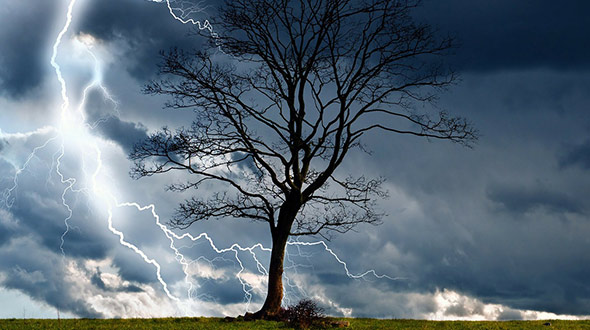
Lightning – By their height, trees are a common target for lightning. Your tree’s bark may be blown off or scars left on the trunk when the electricity is conducted along the outside of the tree. When the electrical charge penetrates the tree trunk, the moisture within the trunk may be converted to vapor and cause the tree to explode.

The most susceptible trees to lightning strikes are poplars, pines, oaks, and elms.

Course of action: Install lightning rods on your property and to the top of your home to divert lightning from your trees.

Ice – Winter snow or ice storms may deposit ice on the foliage and branches of your tree. The weight of accumulated ice on a tree together with wind can break branches or cause the tree to fall.

Hazard assessment to prevent tree damage or collapse under snow and ice weight

Trees resistant to ice damage include oaks, beech, birch, and American hornbeam.

Course of action: As always, maintain the health of your tree throughout its growing season. In the fall, have your trees pruned, and crowns thinned to reduce the potential of ice accumulation.

In some cases, storms can unleash tremendous amounts of rain, wind, flooding, etc. that can bring down weakened and healthy trees alike. However, annual hazard assessments allow you to take actions that minimize damages to your trees and property when they fall.

Tree Health and Hazard Assessments

In this article, you discovered the importance of tree hazard assessments, what tree professionals look for during an assessment, what damages are caused by storms, and what you can do to help your trees through storms.

By scheduling annual tree hazard assessments, you create the possibility to catch and reverse potential threats to your tree’s health. These assessments also enable you to remove trees that can cause catastrophic damages when toppling in storms.

If you neglect to have hazard assessments performed, infestations, soil compaction, or disease may weaken your tree to the point where it falls during a weather event. Thus, endangering your property, home, and life.

Sources:
http://gatrees.org/community-forests/management/trees-storm-safety/storm-preparation/index.cfm
https://www.southernforests.org/urban/trees-and-storm-safety

Todd’s Marietta Tree Services

200 Cobb Pkwy N Ste 428 Marietta, GA 30062
(678) 505-0266

Originally published on: http://www.toddsmariettatreeservices.com/why-do-i-need-tree-hazard-assessment/

Monday, September 23, 2019

How to Stake a Leaning Tree

Staking young trees to avoid weather damage

Your leaning tree can fall, causing catastrophic and life-threatening damages. By staking your tree, you can help it re-establish itself, prevent its death, and eliminate the danger of it falling.

toddsmariettatreeservices.com gathered information on why trees lean, how to properly stake them, and when tree removal may be necessary.

Why Trees Lean

Before taking action to stake or brace a tree, it’s helpful to understand the reasons why trees may lean in different stages of their growth.

The following require staking, bracing, or cabling and can be halted or reversed:

• The tree was planted off-center.
• The tree may be leaning towards the sun.
• The root ball has shifted in unsteady soil.
• Constant wind has shaped the tree to curve or has moved its center of gravity.
• The tree was struck by a vehicle or heavy machinery.
• Neighboring support trees were removed.
• The crown is off-center from poor pruning practices.

The following are irreversible and may require the immediate removal of the tree:

• An earthquake, floodwater, rockslide, or landslide has caused the root plate to destabilize and fail.
• Roots are failing due to rot from disease or poorly-drained soil.
• The tree trunk cracked.

As trees reach maturity, they can weigh from 2,000 to 20,000 pounds. When that weight becomes off-centered, and the tree begins to lean, quick action is required to prevent a fall with potentially deadly results.

Tree bracing and support for uneven crown or leaning tree

Read How to Identify a Tree Emergency, and if you have a mature tree threatening to fall, call a tree professional to evaluate the immediate risk and lay out a course of action.

Tree Support Systems to Prevent or Stop Their Leaning

Support systems for young and leaning trees change as trees mature. The following are different systems used at various stages of tree development:

Planted as a Seedling – For the first 6 months to one year, the tree should be protected from the elements and wildlife by a chickenwire encircling enclosure, lined with burlap on the upwind side.

Transplanted Trees – Bare root and rootball transplants are highly susceptible to the elements until their root system extends and forms a firm root plate. These trees should be staked for 1 to 2 years while this process takes place.

Young trees planted as seedlings should be staked once they outgrow their protective enclosures to prevent leaning or severe weather damage.

To accomplish this:

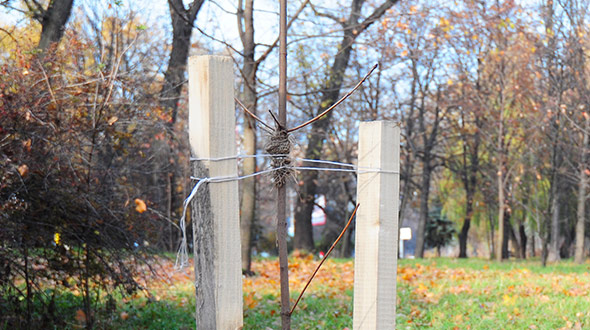
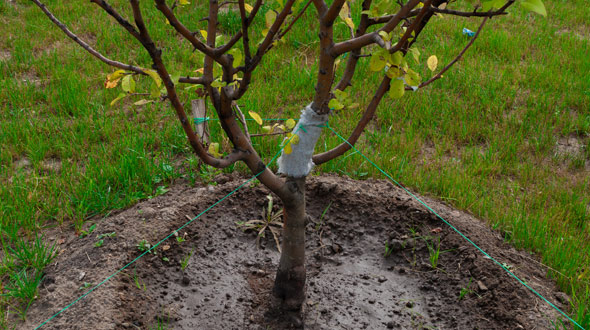
1. Drive two 8 foot stakes 2 feet into the ground on either side of the tree trunk (about 1 1/2 feet from the trunk on each side).
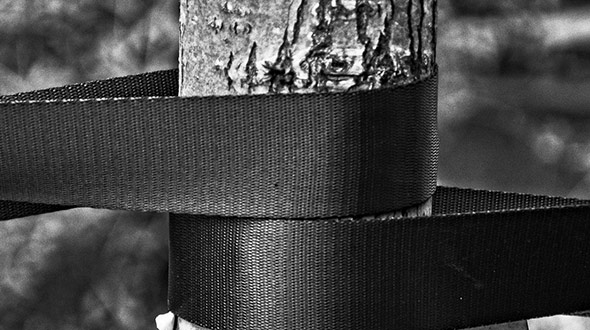
2. Tie or attach a piece of burlap or other soft material – looped around the trunk – to each of the stakes. There should be enough slack for the tree to sway 3 to 6 inches in all directions before the material tightens around the trunk.
3. If wildlife is an issue, surround the tree with chicken wire using the stakes as a harness.
4. While a tree is staked, check the bark where any contact is made frequently. If damage or wear is detected, move the material up or down on the stakes.

Tree stake tether with slack for natural trunk movement

Never tie or attach anything to trees being staked. Besides bark damage, the tree could end up girdled or sawed through if there is constant friction.

This staking method is highly effective until the trunk reaches a diameter at breast height (DBH) of 4.5 to 6 inches, at which point stronger measures are required.

Trees with a DBH >6 inches – When trees reach this size, they are heavy enough to cause severe to catastrophic damage if brought down during a storm or fall from their own weight. If they begin to lean, take the following actions immediately:

Leaning tree crown thinning to establish center of gravity

• Prune the tree to reset its balance or center of gravity.
• Cabling the tree can relieve pressure from branches, causing a redistribution of weight and stress within the crown.
• Anchor the tree to stop or reverse the lean by:

1. Driving a 5-foot heavy-duty iron stake into the ground 8 to 10 feet opposite the direction of the lean (this stake will be supporting tremendous weight).
2. Attach a cable rated for 1,400 to 1,960 pounds to the stake equipped with a turnbuckle or winching device, and loop the other end around the tree trunk above the first branches.
3. Use foam or rubber as a cushion to prevent the cable from directly contacting the tree’s bark.
4. Tighten the turnbuckle until the cable is firm. Then further tighten the cable every other day.
5. This process can last weeks and be successful provided there are no underlying issues with root rot or disease.
6. Call a professional to evaluate the state of the tree and offer guidance.

In all of the above situations, a tree professional should be called to evaluate the tree, determine why it is leaning, and what actions to take.

Staking Leaning Trees

Trees lean for different reasons, but there are various support systems to be used at different stages of the development of a tree.

In this article, you discovered why trees lean, how to stake or secure them properly, and when tree removal becomes necessary.

When your tree begins to lean, it is telling you something is wrong. Don’t procrastinate and allow a leaning tree to fall on your home or loved ones.

Sources:
gatrees.org/community-forests/ask-the-arborist/LeaningTrees-Whatsupwiththat.pdf
hort.ifas.ufl.edu/woody/cabling.shtml

Todd’s Marietta Tree Services

200 Cobb Pkwy N Ste 428 Marietta, GA 30062
(678) 505-0266

Originally published on: http://www.toddsmariettatreeservices.com/how-to-stake-leaning-tree/

Thursday, May 23, 2019

How to Grow an Apple Tree in Marietta Georgia

Apple tree planting and harvest in Marietta Ga

So you want free apples for life? It’s as simple as planting a tree, but there are some things you must know before trying to grow an apple tree in your backyard.

Growing apple trees may seem easy, and it is when you know how to acclimate them and care for them as they mature. By using simple care techniques, you’ll be harvesting homegrown apples before you know it.

toddsmariettatreeservices.com gathered information on how to acclimate, plant, and care for apple trees until they begin to bear fruit.

Apple Trees from Seeds, Seedlings, or Saplings

If you want to grow and harvest your favorite apples, your first decisions are which species of apple and in what phase of growth to start. The following will help you decide:

Starting from Seeds – If you can create and maintain a controlled environment for seeds to sprout and flourish in, it is the longest but most engaging way to grow your apple trees.

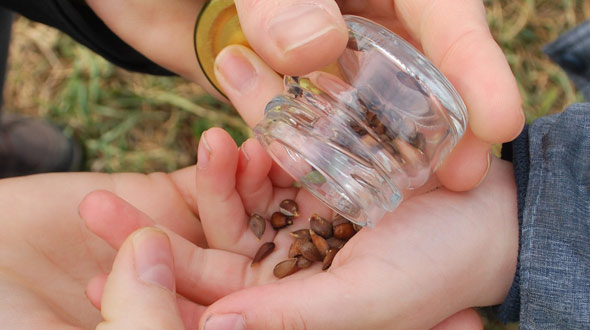
Planting fertile apple tree seeds

Eating an apple and retrieving the seeds from the core may seem like a logical way to get started, but store-bought hybrid apples typically do not have viable seeds or seeds that will grow true to the species. Your best bet is to visit your local nursery or the plant and garden section of your local home improvement store for viable, fertile seeds.

Starting from Seedlings – Seedlings are a great way to start growing a tree. However, they are still fragile and require a controlled environment for the first few months of growth. Seedlings should be allowed to acclimate to their new environment for 5 to 10 days before being transplanted to a larger container.

Apple tree seedling growing in container

Once seedlings “get a feel” for their new location, they tend to grow fairly rapidly. However, seedlings will require several transplants before finally moving them outside for acclimation and to their permanent location.

Starting from Saplings – This is perhaps the easiest way to grow your apple tree. Besides circumventing all of the care and precaution needed for seeds and saplings, saplings are almost ready to be planted in their permanent location.

Saplings should be acclimated to the outside environment by leaving them in partial shade for 3 to 4 hours daily, for 7 to 10 days. Once a sapling has been acclimated, it can be transplanted to its permanent outside location.

Planted apple tree sapling in Marietta Ga

Apple Tree Needs

Before planting your apple tree in its permanent location in late winter or early spring, read toddsmariettatreeservices.com/expert-shares-5-important-tree-planting-tips/, then consider these specific apple tree requirements:

Sun Requirements – For best growth and fruiting, your apple tree should get full sunlight (this is 6 or more hours of direct summertime sunlight daily).

Spacing Requirements – Regular apple trees require 25 to 30 feet between trees; semi-dwarf apple trees need 15 to 20 feet, and the dwarf species can be spaced 10 to 15 feet apart.

Regular sized mature apple tree spacing 30 feet between trees

Soil Requirements – Apple trees can thrive in soils ranging from medium textured clays to gravelly sands. However, the healthiest trees and best crops are found on well-drained fertile sandy soils and loams.

Apples do best in neutral to slightly acidic soil with a pH between 7.0 and 5.8. You can amend the pH level in acidic soil by incorporating lime before transplanting.

Crown rot (Phytophthora cactorum) is a common issue in poorly drained soil. Apple tree rooting is typically shallow, and wet soils tend to restrict root development. This subsequently results in poor anchorage and reduced extraction of nutrients for tree development.

Watering Requirements – Although apples contain high water content, apple trees do not need daily heavy watering. However, you should adjust your watering schedule to avoid dry soil and drought stress to your trees.

Water your trees in the early morning, or if your schedule doesn’t permit it, early evening watering will help your apple trees thrive.

Your watering schedule should increase in frequency as your apple trees begin to bear fruit, and return to normal after the harvesting period.

Pruning Requirements – Prune your apple trees in late winter, while the trees are in a state of dormancy. Remove any downward growing branches and dead or diseased branches; also remove any suckers growing from the base of the tree or within the root spread.

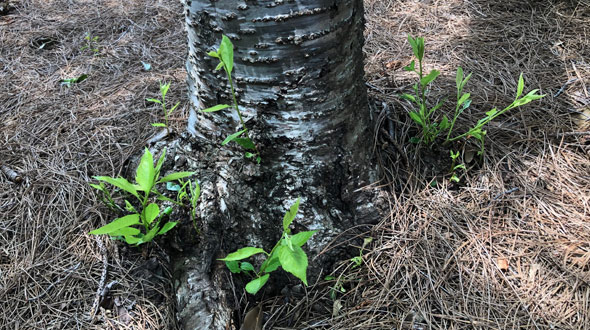
Suckers growing from tree trunk and roots

As pruning stimulates new growth, only emergency pruning (diseased branches, weather damage, etc.) should take place in late summer or fall. Any growth late in the season will not have time to harden in preparation for winter months dormancy and will die.

Pollination Requirements – On average, newly planted apple trees require 2 to 5 years to establish, mature, and bloom. Some species take 5 to 10 years to bloom and bear fruit. Like all fruit trees, pollination is required for apple trees to bear fruit.

Unless the species is self-fertile (Anna, Golden Dorsett, Gordon, etc.), cross-pollination is required. However, self-fertile species bear more heavy crops when cross-pollinated.

Proper pollination occurs when trees of different varieties bloom at the same time. Trees of the same variety won’t get the job done.

If you only have room for one apple tree and natural cross-pollination isn’t possible, you can purchase apple pollen from a local nursery and pollinate the tree by hand (be sure that the species are compatible for best results).

Watch this video to learn more about apple tree pollination.

Growing Apple Trees

With all the free apples after your first harvest, will you make apple pies, apple fritters, or apple sauce? By following these simple planting and care techniques, your apple trees will thrive and provide free apples for years to come.

In this article, you discovered how to acclimate your saplings, planting requirements, and care tips to give your apple trees their best chance to mature, thrive, and bear fruit.

It’s not enough to just plant an apple tree and hope it does well. For your apple tree to thrive, you must be knowledgable and pay attention to a host of easy to learn factors.

Sources:
https://www.yara.us/crop-nutrition/apple/agronomic-principles/
http://extension.uga.edu/publications/detail.html?number=C740&title=Home%20Garden%20Apples
https://www.allotment-garden.org/fruit/apples-growing/

Todd’s Marietta Tree Services

200 Cobb Pkwy N Ste 428 Marietta, GA 30062
(678) 505-0266

Originally published on: http://www.toddsmariettatreeservices.com/how-to-grow-apple-tree-marietta-georgia/

Wednesday, December 26, 2018

5 Marietta Ga Tree Diseases – Identification and Treatment

Fallen diseased tree Marietta Ga

That concerning tree in your yard may be diseased and risky to leave unaddressed. However, inaction is what often leads to severe and avoidable damage.

While diseased trees can pose a threat to your landscape, property, and surrounding people, identifying and treating such cases properly can mitigate and prevent disastrous tree fall situations.

toddsmariettatreeservices.com names five common tree diseases in Marietta GA, how to identify, treat, and when to have the tree evaluated by a professional.

Fire Blight Symptoms and Treatment

Fire blight is a disease that flourishes in humid, rainy weather when the average temperature rises to 60 degrees Fahrenheit and above.

Symptoms – As the name implies, symptoms of this disease cause the appearance of fire scorching or burning. When inspecting your tree, look for these signs:

• Infected flowers turn black and die.
• Twigs and stems turn black and curl over.
• Branches appear scorched as their leaves turn black and shrivel up.
• Cankers will appear on branches and the trunk.

Transmission – Fire blight is easily transmitted to other trees, shrubs, and plants by birds, animals, splashing water, and unsterile gardening tools.

Fire blight tree disease transmission in Marietta Ga

Treatment – The following measures should be taken immediately to eliminate and prevent the spread of fire blight:

• Apply a copper fungicide before the flowering season.
• Extensive pruning of all affected areas.
• Take pest control measures to eliminate ants and other insects which may transmit the disease.
• Convert your watering method to drip lines. (Avoid sprinklers or spraying)
• Sanitize gardening equipment with a water and bleach solution after use on infected landscapes.

Call a Professional – When more than 25% of a tree must be removed, seek the advice of a professional tree service or arborist. It may be necessary to remove the tree altogether. Likewise, when multiple trees, shrubs, and plants are infected, a professional can help you devise a plan to halt the disease.

Powdery Mildew Symptoms and Treatment

Much like fire blight, powdery mildew thrives in the springtime when temperatures range from 60 to 80 degrees Fahrenheit. There are several fungi which can produce powdery mildew.

Symptoms – As the name suggests, powdery mildew can appear on any part of its host and resembles white or slightly off-white mildew. Numerous spores begin to emerge as the fungi mature.

Transmission – Insects such as aphids are the principal means of transmission. However, when spores are released, splashing water or wind may spread the fungi.

Powdery mildew tree disease transmission in Marietta Georgia

Treatment – The following measures will help you control and eliminate powdery mildew from your landscape:

• Apply non-chemical organic fungicides such as milk, bicarbonates, and oil. An effective solution is diluted at 1 part fungicide to 10 parts water. This fungicidal mix produces outstanding results when used for preventative measures or sprayed directly on the infected plant.
• Applying a neem oil solution disrupts the fungus’ metabolism – preventing spore production.

Call a Professional – When topical treatment can’t stop powdery mildew, or when it eliminates powdery mildew, but your tree’s health continues to decline, there may be another pathogen or insect at work. Request an inspection and evaluation from a tree care professional.

Anthracnose Symptoms and Treatment

Anthracnose thrives in the springtime with prolonged periods of rainfall and when temperatures are consistently mild.

Symptoms – The symptoms of anthracnose include the following:

• Bud and twig death
• Dead spots on leaves
• Dead tissue or blotches along and between leaf veins
• Unseasonal or premature leaf-drop
• Lesions known as cankers in tree bark (open wounds)
• Dark colored pimple-like fruiting structures (acervuli) on the underside of leaves.

Anthracnose disease infected tree in Marietta Ga

Transmission – Similar to fire blight, anthracnose is easily transmitted to other trees, shrubs, and plants by wildlife, splashing water, rain, and unsterile gardening tools.

Anthracnose fungi (there are several fungi which can cause anthracnose) can survive the winter months in fallen leaves, or in cankers formed in the bark of branches or the trunk.

Treatment – The following measures should be taken immediately to eliminate and prevent the spread of anthracnose:

• Extensive pruning of all affected parts.
• Utilize a fire pit or bonfire to destroy affected clippings and foliage.
• Convert your watering systems to drip lines. (Avoid sprinklers or spraying)
• Sanitize gardening equipment with a water and bleach solution after use on infected landscapes.

Read the following article for more on How to Identify, Treat, and Prevent Anthracnose.

Call a Professional – When 25% or more of a tree must be removed, seek the advice and assistance of an arborist or reputable tree service.

It may be necessary to remove the tree altogether. Without treating anthracnose, you will be leaving your tree susceptible to other infections and infestations.

Root Rot Symptoms and Treatment

Changes in landscaping, soil compaction, soil composition, or persistent rains may cause root rot.

Symptoms – Severe and fast branch die-back, premature color change of the leaves, widespread leaf spots, sap coming from the bark, and mushrooms around the root flare may all indicate root rot.

Transmission – Root rot is typically the result of poor drainage or changes in the soil composition and texture. This either kills the roots or allows access to pathogens, which weakens and eventually kills them.

Treatment – If your tree is diagnosed with root rot, the recommended treatment is to have the tree removed.

Diseased tree dying from root rot in Marietta Georgia

To prevent further cases of root rot, ensure that the soil in your landscape is well-drained, and that roots are protected from soil compaction.

Call a Professional – If you suspect that a tree is suffering and dying from root rot, call a professional to have the tree evaluated immediately. Depending on the size of the tree and the amount of damage to the roots, the tree may fall at any time.

Heart Rot Symptoms and Treatment

When a fungal disease causes the softening and decay of the wood found at the center of a tree’s trunk and branches, this is known as heart rot.

The softening of the heartwood leaves a tree vulnerable to the pressure of its own weight and prone to collapse.

Symptoms – A reliable indicator that heart rot is present within a tree is the presence of fungus conks or mushrooms growing from the tree’s trunk or branches.

Transmission – Heart rot is able to attack the heartwood of a tree through damaged bark or improper pruning.

Tree dying from heart rot disease in Marietta Ga

Treatment – Control of heart rot is achieved by:

• Maintaining your trees healthy and vigorous.
• Using proper pruning techniques.
• Having the trees inspected by an arborist annually.
• Providing post-storm care and maintenance.

Heart rot affects trees across the world. When trees are healthy, they are able to isolate and stop this disease through a process called compartmentalization.

Call a Professional – If you suspect that your tree is suffering from heart rot, do not hesitate to call a professional tree service to evaluate the tree and recommend a course of action. Act promptly, as trees that suffer from this disease can cause catastrophic damages when they collapse unexpectedly.

Tree Disease and Landscape Health

Because diseased trees are susceptible to fall at any time, it is imperative to be educated and swift in taking action to treat these disease cases.

Discovering how to identify and treat the diseases that are common in Marietta Georgia is a great start.

Being informed and giving more attention to your trees may seem like extra effort, but sleeping well at night knowing your property and people are safe is worth the energy.

Sources:
http://extension.uga.edu/publications/detail.html?number=B1238&title=Common%20Landscape%20Diseases%20in%20Georgia
http://www.gfc.state.ga.us/community-forests/management/tree-care/insects-and-diseases/index.cfm

https://plus.google.com/+Toddsmariettatreeservices

Todd’s Marietta Tree Services

200 Cobb Pkwy N Ste 428 Marietta, GA 30062
(678) 505-0266

Originally published on: http://www.toddsmariettatreeservices.com/5-marietta-ga-tree-diseases-identification-treatment/

Tuesday, November 27, 2018

How to Identify, Treat, and Prevent Anthracnose

Anthracnose acervuli colletotrichum tree disease

You may be unknowingly spreading disease all over your landscape. Those yellow, brown, or black spots on your tree may be anthracnose. Avoid hosing down your tree to try and clean it, you could be spreading this fungi everywhere!

Over time and repeated attacks, anthracnose can weaken your tree’s health and provide an opportunity for other disease and infestation. Once identified, tree anthracnose should be treated immediately.

toddsmariettatreeservices.com gathered this information to help you identify, treat, prevent anthracnose, and uncover the fungi responsible for causing it.

What Is the Cause of Anthracnose?

Tree anthracnose is caused by a fungal infection fueled by optimal weather conditions. The following are some of the fungi responsible for anthracnose and some of the tree species they infect:

Anthracnose tree disease dead spots on leaves Marietta
  • Apiognomonia Errabunda – Attacks tilia, Quercus, beech, oak, lindens, and Fagus (ficus) trees.
  • Apiognomonia Veneta – Attacks london planes and sycamores.
  • Colletotrichum Gloeosporioides – Attacks ash, tulip, and cacao or cocoa trees.
  • Discula Fraxinea – Attacks maple, ash, and fringetree.
  • Glomerella Fungi Species – Attacks banana, mango, papaya, and lemons.
  • Gnomonia Fungi Species – Attacks oak, maple, sycamore, walnut, ash, and dogwood trees.
  • Marssonina Fungi Species – Attacks aspen, poplars, and cottonwood trees.
  • Stegophora ulmea – Attacks elm trees.

The above-mentioned fungi overwinter in either the leaves that have fallen to the ground, or in cankers on the tree’s bark. In springtime, the fungi’s reproduction process is favored by cool temperatures and prolonged periods of rain.

Tree disease canker Marietta Georgia

As the fungi generate spores, splashing rain, overhead watering, and/or the wind disperses them to leaf buds, shoots, or young leaves. The fungi then colonize the tissue of the new host and begin producing spores to be carried off in the same manner.

As long as temperatures remain mild and moist conditions persist, the fungi will continue to colonize leaf tissue, produce spores, and reinfect the same leaves or spread to others. Without intervention, this process can repeat itself throughout spring and into early summer.

Tree disease leaf spot anthracnose Marietta Ga

Anthracnose and other fungal diseases that attack trees need water (moisture) to grow, propagate, and colonize new hosts. These diseases are less common in warmer regions that have less rainfall.

What Are the Symptoms of Anthracnose?

While anthracnose can be caused by several different species of fungi, the symptoms are the same. Here is how to identify an anthracnose infection:

  • Bud death
  • Twig death
  • Dead spots on leaves
  • Dead tissue along leaf veins
  • Dead blotches between leaf veins
  • Unseasonal or premature leaf-drop
  • Lesions known as cankers in tree bark (open wounds)

A common symptom among all of the anthracnose diseases is the presence of acervuli. Use a magnifying glass to examine the underside of infected leaves. You are looking for dark colored pimple-like fruiting structures (acervuli).

Tree disease anthracnose acervuli Marietta Ga

In infected trees, these structures may also be found peppered along dead twigs.

How Do You Treat Anthracnose?

While damages resulting from anthracnose infections are generally inconsequential to the overall health of a tree, repeated attacks from the disease year after year can weaken a tree’s defenses enough to leave it susceptible to other diseases and insect infestations.

The following measures will help to treat the disease and reduce the potential for infection in the coming springtime:

Don’t Spray the Foliage – Anthracnose fungi depend on splashing water and wind to carry them from one host to another. If you try to wash off the foliage, you are doing more to help the fungi live than to save your tree.

Fallen Leaves – Collect and destroy fallen leaves. These dead leaves (if left on the ground) provide an optimal location for fungi to overwinter.

Anthracnose fungi tree leaves Marietta Ga

Pruning – For the fungi and acervuli found in blighted twigs, these areas should be pruned back and destroyed.

Crown thinning will allow more air and light to reach the inner branches and foliage, which in turn will help fight against the fungi.

Depending on the extent of the infection, excessive pruning may be necessary. If this is the case, contact a professional tree service to evaluate the situation.

Tip: To destroy the pruned portion of the tree and/or leaves, light up the fire pit or have a bonfire.

After pruning any diseased plant, shrub, or tree, make certain that your tools are sanitized before storing them or using them again. Use a 1 part bleach to 6 parts water solution to wash your tools.

Tree pruning trimming equipment anthracnose

Fungicides – In areas or with trees that have a history of anthracnose infections, fungicides can be used to further curtail its spreading.

Knowing the species of your tree will help you select the right fungicide. Many of them are labeled for use against specific fungi, and the fungi which cause anthracnose are typically host species specific.

How Can Anthracnose Be Prevented?

By providing plants and trees with well drained and enriched soil, nutrient-rich fertilizer, sufficient water, and annual pruning, you will help them maintain a vigorous defense system and enable them to resist diseases more handily.

If you use a sprinkler or overhead watering system, consider modifying it or replacing it with a drip system. Drip systems don’t create the splashing effect necessary to carry fungus spores from host to host.

Anthracnose prevention drip line watering system

Finally, take action against other fungal invaders and pests to prevent the tree’s health from weakening.

Tree Health and Disease Prevention

There is more to preventing tree diseases than just hosing down your trees. To stop the spread of anthracnose and prevent its return, it takes an understanding of what it is and how it spreads from host to host.

In this article, you discovered what causes anthracnose, how to correctly identify it by common characteristics, how to treat it, and the steps to prevent it.

Anthracnose, through repeated attacks, will eventually weaken your tree and allow other more invasive diseases and tree pests to attack. Treatment and prevention measures should begin as soon as this disease is positively identified.

For more signs and symptoms of a troubled tree, visit http://www.toddsmariettatreeservices.com/troubled-tree-signs-symptoms/

Sources:

http://ipm.ucanr.edu/PMG/PESTNOTES/pn7420.html
https://extension.psu.edu/anthracnose-on-shade-trees
https://wiki.bugwood.org/HPIPM:Anthracnose_Diseases
https://www.ppws.vt.edu/content/dam/ppws_vt_edu/extension/plant-disease-clinic/files/clinic-report-2013.pdf
https://www.cabi.org/isc/datasheet/25356

Photchana Trakunsukharat, Department of Agriculture, Thailand [CC BY 3.0 au], via Wikimedia Commons

https://plus.google.com/+Toddsmariettatreeservices

Todd’s Marietta Tree Services

200 Cobb Pkwy N Ste 428 Marietta, GA 30062
(678) 505-0266

Originally published on: http://www.toddsmariettatreeservices.com/how-to-identify-treat-prevent-anthracnose/

Friday, October 12, 2018

Insecticidal Soap Recipe to Control Tree Pests

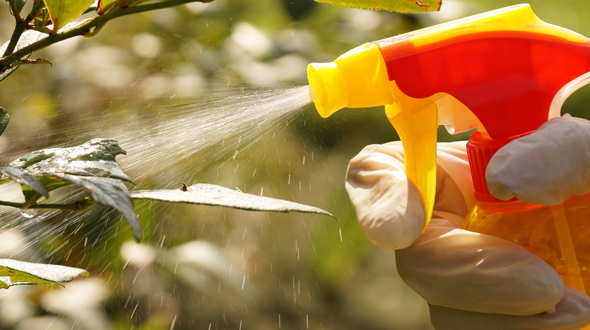
Tree pest control homemade insecticidal soap spray

Controlling nasty tree pests is easy and you can do it without toxic chemicals. For more than two centuries, variations of homemade insecticidal soaps have been used to control invasive tree and garden insects.

Homemade insecticidal soaps are easy to use and safer than conventional or industrial pesticides. Using them will save you from unnecessary exposure to the components of store-bought pesticides.

In this article, the professionals at toddsmariettatreeservices.com explain how to make and apply homemade insecticidal soaps, how they work, and which insects to target.

How to Make Insecticidal Soap

The ingredients to make an insecticidal soap can typically be found in your kitchen or pantry and only require the use of a tablespoon, a measuring cup, a gallon jug, and a spray bottle.

Insecticidal soap recipe Marietta Georgia

This recipe yields 1/2 gallon of solution.

You will need:

Regular liquid dishwashing soap (Dawn, Lemon Joy, Ivory, etc. but not the ultra or special formula varieties)

Vegetable oil (peanut, corn, canola, sunflower, etc.)

Warm water (preferably filtered or soft water, but tap water will do)

Step 1 – Pour 1/2 cup of the vegetable oil In the measuring cup, and mix 3 Tbsp of the dishwashing soap with it. Mix well.

Step 2 – Pour the oil and dishwashing soap into a 1-gallon jug, then fill the jug with water to approximately the halfway mark.

Step 3 – Shake well and fill your spray bottle. Keep the remainder (left in the jug) in a cool, dry place. It will get used.

That’s it. You’ve made a basic insecticidal soap. Read on to learn how to apply it and what variations are needed for different insects.

How to Use Insecticidal Soap

Using these soaps is as easy as making them. Follow these steps to apply your homemade insecticide effectively.

Step 1 – Locate the infested or troubled area of your tree.

Step 2 – In the early morning or late afternoon, spray the solution directly on the insects and surrounding foliage.

Step 3 – Repeat Step 2 after one week. And again one week later.

Throughout this process, keep an eye on the foliage that is being treated. Some tree and plant species are more sensitive than others and may slightly wilt or change color. If this is the case, add more water to the solution to dilute it.

If the infestation persists after three weeks of treatment, call on a professional tree service to evaluate the severity of the infestation and what further steps should be taken to halt it.

Tree Bugs – Which Ones Are Affected?

The recipe above works best on soft-bodied insects which include:

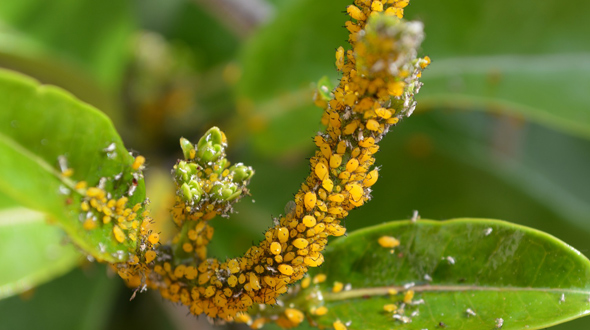
• Aphids
• Scales
• Mealybugs
• Spider Mites
• Whiteflies
• Psyllids

Insecticidal soap tree pest control Marietta Ga

The solution is also effective against Boxelder bugs.

Control of the above insects typically results from either a disruption of their cell membranes or the removal of the waxes that cover the insect, resulting in death by dehydration.

Add 2Tbsp of peppermint oil to your mixture for hard-bodied insects such as:

Weevils
Springtail
Thrips

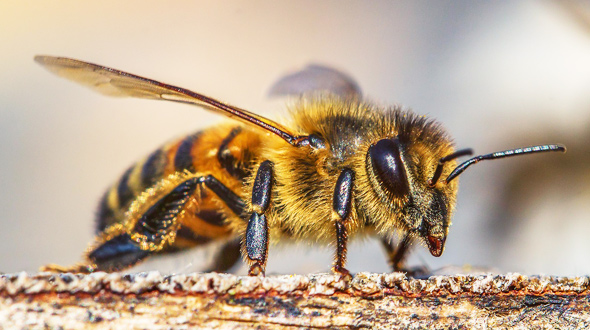
Beneficial insects like Lady Bugs, bees, and lacewings are not typically affected by soap sprays.

Tree bugs insecticidal soap spray Marietta Ga

When the invading insects are beetles, the following recipe will help discourage them from burrowing into your tree.

Tree pest control insecticidal soap recipe Marietta Georgia

This recipe yields 1 gallon of solution.

You will need:

1 cup dried cayenne peppers
1 cup rough chopped fresh jalapeño peppers
1 gallon water

Step 1 – Add the cayenne, jalapeño peppers, and 1/2 gallon of water together in a pot.

Step 2 – Bring the water to a boil and reduce to a simmer for 45 minutes.

Step 3 – Allow time to cool before straining out all of the solids.

Step 4 – Add the strained solution to a 1-gallon jug, then complete the jug with water.

Step 5 – Carefully pour the desired amount into a spray bottle. Keep the remainder (left in the jug) in a cool, dry place. (read below before use).

When applying this “pepper” solution to trees or plants, it is strongly advised to wear protective gloves and eyewear. Once applied, reapplication is only necessary after rain.

Homemade Bug Spray for Trees and Outdoor Plants

The recipes and application methods for the homemade insecticides above can be used on garden plants as well as trees. This easy to use alternative allows you to avoid using chemically produced and potentially hazardous pesticides.

In this article, we’ve detailed two basic homemade insecticide recipes and several variations to help you combat infestations from beetles, soft-bodied insects, and hard-bodied insects.

The benefit of using a homemade insecticide is that you can control pest issues while avoiding exposure to the harsh chemicals used in the production of industrial or commercial insecticides.

Sources:

http://cecentralsierra.ucanr.edu/files/170225.pdf
https://www.ctahr.hawaii.edu/UHMG/downloads/UHMG-home-recipes.pdf
http://extension.colostate.edu/topic-areas/insects/insect-control-soaps-and-detergents-5-547/

https://plus.google.com/+Toddsmariettatreeservices

Todd’s Marietta Tree Services

200 Cobb Pkwy N Ste 428 Marietta, GA 30062
(678) 505-0266

Originally published on: http://www.toddsmariettatreeservices.com/insecticidal-soap-recipe-control-tree-pests/

Thursday, September 13, 2018

How to Identify a Tree Emergency

Marietta Georgia emergency tree removal

Tree emergencies come in all shapes and sizes. Many times, there is an emergency situation brewing underneath the surface and goes unnoticed until it’s too late and catastrophic damage is done.

Part of being a responsible and prepared property owner is learning to identify the warning signs of a tree emergency and how to take preemptive action.

In this article, the professionals at toddsmariettatreeservices.com explain how to identify tree problems which constitute an emergency, and what proactive measures to take to avoid expensive damages and repairs.

Tree Emergencies in Marietta GA after Severe Weather

Marietta Georgia is no stranger to storms that swoop in with damaging rain and winds. Trees are vulnerable and may sustain injuries in such weather events. After the storm has passed, one of the first things to do is inspect your trees and look for the following:

My Tree Is Leaning – When a tree suddenly leans, there is much to be concerned about. At the very least, the roots have lost their grip in the ground, and the weight of the tree is no longer balanced.

Emergency tree removal leaning Marietta Ga

Depending on the size (height) and age of the tree, corrective measures may solve the problem. Taller and older trees will likely require emergency removal to avoid catastrophic property damage or loss.

Action Required: Immediately contact a professional tree service to evaluate the tree and offer a solution.

A Large Branch is Broken and Hanging – While this may seem like a simple problem to solve, it may be an indication of underlying health issues.

If your tree is located in an area that has been affected by prolonged periods of drought, the tree itself may be brittle, posing the threat of other falling branches.

Many species of fungi are able to invade a tree and cause the slow deterioration of the heartwood. If this is the case, the tree may very well be dead and at risk of collapsing under its own weight.

Trees grow based on symmetry and balance. If the branch in question is large enough or contains a significant portion of the crown, the stability of the tree may be compromised. In severe enough cases, emergency tree removal may be the only viable option.

Action Required: DO NOT pull or tear the branch down – this may cause irreparable damage to the tree. Contact a reputable tree service to properly remove the branch and ensure that the tree is stable and in good health.

Sections of Bark Are Missing – During severe storms, the wind may carry unsecured objects as projectiles and launch them into a tree trunk, damaging or stripping the bark away.

Tree emergency bark damage Marietta Ga

Just below the bark is the xylem and phloem which transport water and nutrients throughout the tree. If large portions of the bark have been damaged or are missing, this may girdle (strangle) the tree.

Action Required: This is a serious situation requiring immediate attention which the tree may not recover from. Call in an arborist to evaluate the tree’s condition and prescribe the necessary action.

Learn about tree preparation for storms toddsmariettatreeservices.com/hurricane-planting-tips-trees-marietta-ga-landscape/.

Signs of Tree Health Problems

When a tree’s health is compromised, one or a combination of the following signs will be visible (outlined after the below signs are the necessary actions to address and resolve them):

Wilted or Discolored Leaves – If the wilting or discoloration is in the entirety of the canopy, it could mean that the tree is suffering from drought or soil compaction.

However, if the symptoms are confined to a section of the canopy with no physical bark / branch damage or beetle infestation, it is likely a tree disease.

Mushrooms Growing on The Tree – This may be an intriguing visual, but it is a symptom of a grave issue within the tree.

Tree emergency Marietta Ga

Mushrooms require rotting tissue for their growth. If you see mushrooms sprouting from your tree, you can assume that heart rot is the front-runner of potential culprits.

Dieback – This symptom becomes evident when the extremities of a tree wilt and die, working its way to the center.

Dieback occurs when a disease has infected the tree, or the environment has changed to unfavorable and damaging growth conditions.

Insect Infestation – Trees in good health are typically able to resist insect infestations. That said, boring insects such as beetles may still be able to attack a healthy tree.

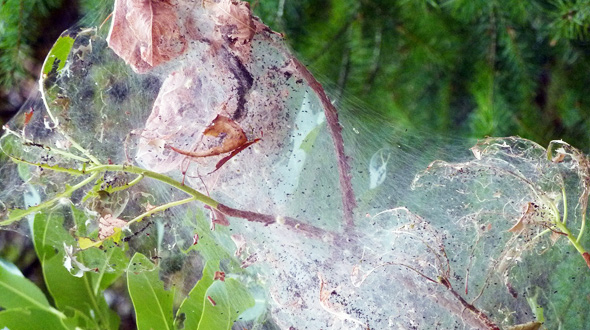
Look for webs in the tree, sooty mold on or under the leaves, leaves that have been eaten (chewed up), or entry holes and sawdust from burrowing insects. These are all signs that insects are using your tree to propagate their species.

Actions Required: Addressing the above tree health problems can be divided into three categories:

1 – Burrowing Insects – Seek immediate assistance from a tree service to determine the extent of the damage, to exterminate the insects (if possible) and to contain the infestation from spreading to other trees.

2 – Wilt, Dieback, and Mushrooms – These signs indicate serious health problems within the tree and require a professional approach to either bring the tree back to health or remove it to avoid spreading the problem to neighboring trees.

3 – Non-Burrowing Insects – Neem oil or a homemade insecticide (basic recipe below*) can be applied to the infected and surrounding areas of the tree to halt their activities. If this approach does not resolve the pest issue, or the tree is presenting other visual symptoms, call in an arborist or reputable tree service to evaluate the tree’s health.

Insect infestation tree emergency Marietta Ga

*Basic Insecticidal Soap Recipe – This recipe requires three ingredients: dish soap, vegetable oil, and water. Add 2.5Tbsp of dish soap and 2.5Tbsp of vegetable oil to 1 gallon of warm water and mix it well. Apply as needed.

Identify and Correct Tree Health Emergencies in Marietta Ga

With the above knowledge, you will be aware of the signs of a troubled tree, the potential results of inaction, and the best course of action to take. Take the time to examine your trees with a renewed perspective.

Everything from insect infestations and invasive fungi to compacted soil, damaged roots, and severe weather events can cause the decline of your tree’s health. Identifying the warning signs and taking action is a crucial step toward its recovery or a required emergency removal.

To help prevent tree health issues, schedule an annual inspection with a professional tree service, and keep proper pruning activities limited to late winter or early spring.

Tree emergency Marietta Ga pruning

Turning a blind eye to your tree’s declining health can result in the death of the tree. If that tree falls, your home, vehicle, and everyone within the fall radius is at risk of costly damages or severe injury. Beware, when a tree falls it does not choose where it is safe to land.

https://plus.google.com/+Toddsmariettatreeservices

Todd’s Marietta Tree Services

200 Cobb Pkwy N Ste 428 Marietta, GA 30062
(678) 505-0266

Originally published on: http://www.toddsmariettatreeservices.com/how-to-identify-tree-emergency/

Friday, July 20, 2018

How Do Trees Grow?

Tree meristem tissue new growth Marietta Georgia

Simply put, trees grow up, trees grow out, and trees grow down. In one form or another, trees are always growing throughout their lifecycle, and do so until their death.

Knowing how they grow can improve your landscaping and gardening practices. Our team at Todd’s Marietta Tree Services constructed practical information below about tree growth and will dispel some common myths.

Do Trees Grow from the Bottom Up?

Yes. Trees do grow from the bottom up in the sense that the roots are transporting the “growth” building blocks up the trunk, through the limbs, and to the extremities of the tree.

However, the answer is NO when considering that tree growth occurs from its extremities. Consider the following:

Root Growth – Roots grow outward and down from their tips (similar to how limbs and branches grow longer). As roots grow and age, they thicken (much like the trunk does).

Tree root growth fall and winter

The roots of a tree are able to spread out and grow far beyond the tree’s dripline (the outer edges of the canopy).

Root activities almost exclusively support the growth of a tree. Four primary functions of tree roots are:

  • To seek out sources of water and nutrients.
  • To store glucose in the colder months (when growth is all but halted).
  • To participate in the underground ecosystem through mycorrhizal associations or root grafting.
  • To anchor the tree to the ground.

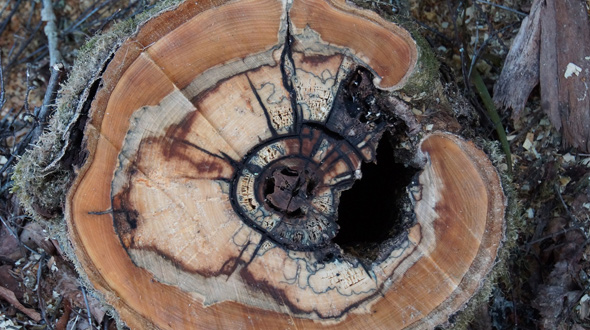
Trunk Growth – The trunk doesn’t stretch or grow upward. It does thicken though, and it adds two rings as each year passes. One light ring during the growth period and one dark ring as it slows down for winter or dormancy.

When looking at a cross-section of a cut down tree, you can tell how old the tree was when it died by counting one light and one dark ring for each year from the outside inward.

Tree trunk cross section age rings

A common misconception is that tree trunks stretch upward as they get taller, when in fact they do not. If you were to pin a medal on the trunk at exactly five feet up from the root flare, it would still be exactly five feet up from the root flare fifty years or one hundred years later.

Branch and Limb – Growth in length happens within meristem tissues located at the tips of branches, stems, and twigs. These specialized tissues facilitate the upward growth of the tree, as well as the expansion of the tree’s canopy.

Tree growth new limb with meristem tissue

Branches and limbs grow in diameter through the vascular cambium within the bark. Very similar to how a trunk grows in diameter.

Do Trees Grow All Year?

While different species of trees will follow slightly different growth patterns, the answer is yes. Trees are continuously growing throughout the year.

Springtime – Foliage, limbs, and branches grow at high speeds in the spring.

Spring tree growth in Marietta Ga

Summertime – This is when trunk and limb diameter growth takes place.

Fall and Wintertime – As the trunk, branches, limbs, and foliage stop growing, the roots continue to expand outward and down throughout the coldest months of the year.

How Do Trees Get Their Mass?

It’s principally carbon. Without carbon, trees could not exist. Every time you exhale, you are providing the building blocks for a tree’s mass. Carbon dioxide (captured from the air) and water (sent to the leaves by the roots) bond together within the leaves of a tree to form carbon molecules.

During photosynthesis, energy from sunlight is transformed into chemical energy and captured within the bonds of those carbon molecules.

Photosynthesis in leaves for tree growth

Those carbon molecules along with hydrogen and oxygen comprise the tree’s food source known as glucose. Each glucose molecule contains six oxygen atoms, six carbon atoms, and twelve hydrogen atoms.

Once a tree has satisfied the activities which keep it alive (cellular respiration), whatever carbon molecules (glucose) are left over are used in the growth process, adding to its mass.

Carbon, oxygen, hydrogen, nitrogen, sulfur, and phosphorus together comprise nearly all of a tree’s mass.

Tree Growth, Sunlight, Balance, and Longevity

While there are many facets that comprise a tree’s mechanisms, it is sunlight that is the driving force behind it all. Throughout the entire lifespan of a tree, it will depend on the sun for energy to grow and thrive.

Tree growth requires sunlight Marietta Ga

Tree growth is symmetrical by nature. Throughout the life of a tree, its growth is consistently seeking balance. Trees will not grow beyond their capacity to support themselves. When stressed they will shed leaves, flowers, fruit and even drop entire branches.

Speaking of thriving, the lifespan of a tree depends primarily on its species and the environment it is growing in. While some palms live to about sixty years old, some pine species make it to well over five thousand years old. And there is increasing evidence that an ancient clonal grove of aspen trees called “Pando” is upwards of eighty thousand years old.

Sources:
https://projects.ncsu.edu/project/treesofstrength/treefact.htm
http://www.dof.virginia.gov/infopubs/_forest-facts/FF-How-A-Tree-Grows_pub.pdf
https://askabiologist.asu.edu/questions/what-oldest-living-thing-earth

https://plus.google.com/+Toddsmariettatreeservices

Todd’s Marietta Tree Services

200 Cobb Pkwy N Ste 428 Marietta, GA 30062
(678) 505-0266

Originally published on: http://www.toddsmariettatreeservices.com/how-do-trees-grow/