Showing posts with label Dead Tree. Show all posts

Tuesday, March 24, 2020

Should I Remove That Dead Tree in My Yard?

Diseased dying and dead tree removal from my yard

Your dead tree may pose a harmful threat to your property and human life in the event of a disaster. Knowing the possibilities and consequences of keeping a dead tree in your yard can lead you to an informed decision about its fate.

toddsmariettatreeservices.com gathered information on how to determine whether to keep or remove a dead in your yard and how it can be repurposed either way.

My Tree Is Dead

A tree, like every other living thing, will eventually die. What to do with it when it dies depends on the following factors:

Diseased Tree – If your tree met its demise due to disease, remove it from your yard. Diseases that infect and kill trees are highly transmissible to plants, shrubs, and other trees.

Dead tree removal with signs of disease

Insect Infested Tree – If your tree died from insect infestation problems, or became infested after it died, have that tree removed immediately. Insects, especially boring insects, can multiply quickly and spread even faster.

Root Rot – Many tree diseases attack the root system and typically occur in poorly-drained soil, causing root rot. Trees dying or dead from root rot can fall at any time, even in the mildest of weather conditions. Trees with this condition should be removed as quickly as possible.

Leaning Tree – If your dying or dead tree starts to lean, take immediate action to have it removed before it loses its center of gravity and falls. For example, a poplar tree that grew to over 100 feet high and weighed well over 10,000 pounds would obliterate whatever it landed on.

Overstory Trees – These are trees that reach or exceed 60 feet in height. Dead overstory trees should be removed to prevent catastrophic damages if they were to fall.

Understory Trees – These are trees that reach heights below 50 feet. In fact, these trees are generally between 12 and 20 feet tall. A dead understory tree can be left in place if:

• After a tree hazard assessment, it is found that the tree poses little to no threat to its surroundings.
• The tree remains disease free and free from infestation.
• Your municipality’s tree ordinance does not require its removal.

For more information about tree hazard assessments, visit toddsmariettatreeservices.com/why-do-i-need-tree-hazard-assessment/

Realistically, there are very few circumstances that support leaving a dead tree standing. However, if these circumstances permit, there is much you can do with the tree.

What To Do With My Dead Tree

Have the tree wholly removed by a professional tree service, unless a certified arborist declares your tree safe. There are many repurposing options for your tree in the following scenarios.

If your tree must be taken down and is free from infestation and disease, consider the following:

• Have the tree cut up for firewood.
• Have the tree turned into wood chips for use as organic mulch.
• Turn the tree into a part of your landscape. As it decomposes, it will provide shelter for wildlife, natural fertilizer for the earth below it, and bark eating animals will have a long-lasting food source.

Dead tree removal cut for firewood

If your tree poses no immediate threat and remains in place, it can be used for the following:

• A standing dead tree, known as a stag, can serve your local wildlife as a sanctuary.
• Paint and decorate your tree to become a conversation piece in your yard.
• Turn the tree into a bird and squirrel feeder (stick seeds and nuts to it using honey and/or peanut butter.
• Apply seasonal decorations to liven up your yard during holidays and events.

Dead tree in my yard festively decorated for the holidays

Tip: If you add lights to your tree, use an LED type light which generates minimal heat and make sure the lights are rated for outdoor use. As your dead tree dries out, it will naturally become more flammable.

Note: Some tree species like aspen or eucalyptus are self-pruning when living (they drop branches suddenly) and should not be left standing after dying. Once dead, self-pruning trees can pose a higher risk of personal injury or property damage as they lose their limbs.

For more ideas about recycling or repurposing a fallen tree, visit toddsmariettatreeservices.com/repurpose-recycle-leave-fallen-tree/

Dead Tree Removal

In this article, you discovered what factors determine the necessity to remove or the ability to keep a dead tree in your yard and what purpose it can serve.

By having your dead tree evaluated by an arborist, you can make an informed decision about the next part of the tree’s journey and purpose.

Your failure to address a dead tree in your yard may result in fines imposed by your municipality, the spread of an infestation or disease, and if the tree should fall, catastrophic damages to your property and/or wellbeing.

Sources:
gardeningsolutions.ifas.ufl.edu/plants/trees-and-shrubs/trees/removing-trees.html
blogs.ifas.ufl.edu/pinellasco/2020/01/29/the-living-dead-trees/
wdfw.wa.gov/species-habitats/living/backyard

Todd’s Marietta Tree Services

200 Cobb Pkwy N Ste 428 Marietta, GA 30062
(678) 505-0266

Originally published on: http://www.toddsmariettatreeservices.com/dead-tree-removal/

Wednesday, October 23, 2019

Why Do I Need a Tree Hazard Assessment

Hazard assessment to prevent tree damage or failure during severe weather

Don’t let your trees threaten your property or life as they destabilize during severe weather. Regular tree assessments and preventative measures can help your trees survive severe storm conditions intact.

toddsmariettatreeservices.com gathered information on why trees need regular hazard assessments, what is examined during an evaluation, the types of damages trees suffer in different storms, and preventative measures you can take.

Tree Hazard Assessments – Emergency and Storm Safety

Tree hazard (or tree risk) assessments provide crucial information to the surveyor and the homeowner about the health and stability of the trees being surveyed. These assessments are used in determining:

• The overall health and stability of a tree
• Whether a tree will remain stable during severe weather events
• If the tree poses an infestation or disease threat to surrounding trees
• If the tree is a threat to surrounding structures or people
• A course of action including pruning or removal

The older your trees become, the more they require hazard assessments. As trees age, they become more massive, less flexible, and in many cases, more susceptible to disease and infestations.

Just as necessary is the assessment of the soil where the tree is rooted, soil erosion can become a significant problem for a tree’s stability. This erosion can cause the root plate to lift during the slightest of winds resulting in an emergency, and the toppling of an otherwise healthy tree.

Without these assessments, your trees can develop irreversible damages from diseases, infestations, girdling, compacted soil, and many other conditions (detected in an assessment) that weaken the tree. All it takes is one severe storm to bring down a weakened tree and cause catastrophic damages.

Follow the link for signs and symptoms of a troubled tree toddsmariettatreeservices.com/troubled-tree-signs-symptoms/

Hazard assessment for diseased or dying trees

What is a Tree Hazard Assessment?

Tree hazard assessments happen when a tree professional or certified arborist physically survey the overall health and stability of a tree. A typical assessment looks for the following:

• Signs of disease
• Signs of infestation
• Abnormal growth habits
• Leaning
• Dead, missing, or damaged bark
• Cracks
• Lightning damage
• Balance and density of the crown
• Dead twigs or branches
• Mushroom conks
• Cankers

These examinations are comprehensive and include assessments of:

• Cut or damaged surface roots
• Lifting of the root plate
• Soil conditions and/or erosion
• Soil compaction
• Pavement over roots
• Topography
• Surrounding structures (targets)
• Typical weather for the location
• Wind exposure
• Vines and other potentially harmful plant species

When a tree professional or arborist performs a tree hazard assessment, he is looking for anything about the tree, its root plate, or environment that could be alarming. Read toddsmariettatreeservices.com/how-to-identify-tree-emergency/ for some warning signs and things to look for that indicate a potential tree emergency, and call an arborist or professional tree service if you suspect something is wrong.

Disaster Tree Damage Caused by Storms

Tree hazard assessments take into account the weather patterns common to the tree’s location. Different elements of weather impact trees differently and may require specific actions to prevent irreversible damages to the tree. The following are some of the weather conditions that can cause a weakened tree to topple and preventative measures:

Tree hazard assessment to prevent property damage during storms

Wind – When wind speeds are high, they can impose tremendous force on a tree. During hurricanes or tornadoes, trees may be stripped of their leaves and branches. These winds are capable of twisting, breaking, and uprooting trees. Also, during major storms, debris may debark the tree requiring its removal after the storm.

Course of action: Promote the health of the tree by fertilizing, mulching, and pruning. Provide deep watering to promote deep root growth, and hire a professional tree service to thin out the crown, reducing the tree’s wind-resistance.

You can also create wind diversions by planting shrubs upwind from your trees or by installing fences along your property line.

Flooding – Erosion caused by flooding can be devastating to all plant life. Floods typically result in the complete saturation of the ground and can quickly destabilize the roots of the oldest and strongest of trees.

Course of action: Plant trees on elevated land and reconfigure your landscaping to facilitate water runoff from your property.

Promote the health of your trees by fertilizing, mulching, and pruning. When floods are caused by storm surge, it is the health of your tree and the depth of its roots that will help determine whether it topples or not.

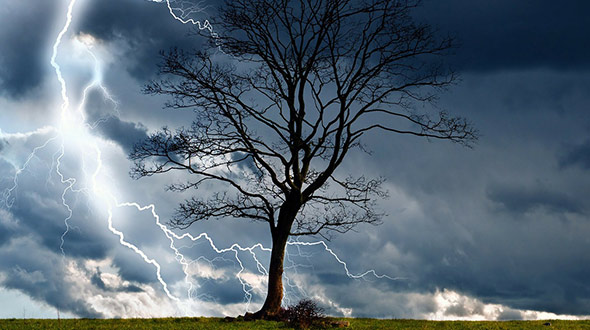
Lightning – By their height, trees are a common target for lightning. Your tree’s bark may be blown off or scars left on the trunk when the electricity is conducted along the outside of the tree. When the electrical charge penetrates the tree trunk, the moisture within the trunk may be converted to vapor and cause the tree to explode.

The most susceptible trees to lightning strikes are poplars, pines, oaks, and elms.

Course of action: Install lightning rods on your property and to the top of your home to divert lightning from your trees.

Ice – Winter snow or ice storms may deposit ice on the foliage and branches of your tree. The weight of accumulated ice on a tree together with wind can break branches or cause the tree to fall.

Hazard assessment to prevent tree damage or collapse under snow and ice weight

Trees resistant to ice damage include oaks, beech, birch, and American hornbeam.

Course of action: As always, maintain the health of your tree throughout its growing season. In the fall, have your trees pruned, and crowns thinned to reduce the potential of ice accumulation.

In some cases, storms can unleash tremendous amounts of rain, wind, flooding, etc. that can bring down weakened and healthy trees alike. However, annual hazard assessments allow you to take actions that minimize damages to your trees and property when they fall.

Tree Health and Hazard Assessments

In this article, you discovered the importance of tree hazard assessments, what tree professionals look for during an assessment, what damages are caused by storms, and what you can do to help your trees through storms.

By scheduling annual tree hazard assessments, you create the possibility to catch and reverse potential threats to your tree’s health. These assessments also enable you to remove trees that can cause catastrophic damages when toppling in storms.

If you neglect to have hazard assessments performed, infestations, soil compaction, or disease may weaken your tree to the point where it falls during a weather event. Thus, endangering your property, home, and life.

Sources:
http://gatrees.org/community-forests/management/trees-storm-safety/storm-preparation/index.cfm
https://www.southernforests.org/urban/trees-and-storm-safety

Todd’s Marietta Tree Services

200 Cobb Pkwy N Ste 428 Marietta, GA 30062
(678) 505-0266

Originally published on: http://www.toddsmariettatreeservices.com/why-do-i-need-tree-hazard-assessment/

Thursday, April 26, 2018

Ways to Repurpose, Recycle, or Leave a Fallen Tree

Trees live, they grow, and they eventually die. Throughout their life cycle, from seedling through their decay, trees play an important role for wildlife and plant life.

Dead fallen tree decaying in water

Once a tree has died, fallen, or been professionally removed, its journey is far from over. If the tree is free from disease and infestation, there are several ways it can be upcycled or used in your landscaping.

The following will offer a look into the life cycle of a tree and present ways to maximize their benefits, even after they have died.

My Tree Was Cut or Fell Over, How Can I Upcycle It?

Depending on the size of the tree and its branches, a fallen tree can offer several innovative ways to decorate your landscape, serve as pieces of furniture, or be made into decorative wall pieces:

  • Stumps, smaller branches, and pieces of the trunk can be used or woven into seating fixtures along a path or in front of a garden.
  • Trunks and larger branches can be cut into thick discs and in the place of stones or bricks to create pathways.
  • Slabs can be cut from trunks and combined with ecopoxy to create stunning tables or wall art.
  • Carved out sections of the trunk can be used as planters.
Fallen dead tree repurposed for planters
  • Branches and stems can be used to create trellises and fencing.
  • Cut and painted logs can become end-tables or coffee tables.
Fallen tree repurposed into table and log seats
  • Smaller branches and twigs can be woven into frames for wall pieces.

There are countless uses, and the more creative you are, the more you will be able to upcycle a fallen tree. In this video, see how resin is combined with wood.

Tree Logs for Landscaping

Tree logs and larger limbs may serve a greater purpose in your landscaping by slowing the effects of erosion by enabling you to create tiers along sloped areas. They also make incredibly effective garden barriers, or when stacked can make a raised flower bed for the garden.

When placed along cemented, paved, or block pathways, not only are they visually appealing, but they impede erosion and protect the pathway’s physical integrity.

Turning Trees Into Mulch and Fertilizer

Another use for a fallen tree in your landscaping is to have the tree chipped and turn it into mulch. Mulch is extremely valuable and beneficial when properly used around the base of trees. It will not only help the soil by retaining moisture, but also by delivering nutrients as the wood chips slowly decay.

However, note that this option is not viable when a tree falls as a result of or is removed due to disease or infestation. Otherwise, the pathogens and diseased matter get exposed to and infect your healthy trees and plants. Learn the signs and symptoms of a troubled tree here toddsmariettatreeservices.com/troubled-tree-signs-symptoms/

Leave a Fallen Tree Where It Lies

When a tree falls or it’s time to be cut down, consider preserving the ecosystem and leaving it as a part of the landscape. It has the potential to serve a greater purpose than if it’s removed. Here are some benefits of allowing a fallen tree to remain:

Light – When a tree comes down, its canopy comes with it. Introducing direct sunlight to the ground that was previously shaded will spark the growth of dormant seeds and other plant life.

Leaving the tree in the area its canopy once covered will help the soil to retain moisture and provide a sort of shelter for the new budding life.

Dead fallen decaying tree in landscape

Food and Shelter – Deer and other bark eating animals will have a lasting food source, while smaller animals like rabbits and squirrels can take advantage of the shelter the tree provides.

Natural Fertilizer – Perhaps the greatest benefit of all is that as the tree decays and breaks down, it is adding natural nutrients to the soil. This benefits all of the surrounding plant life, and is “nature’s” perfect ending to the life cycle of a tree.

Nothing is wasted when left to nature. Thus, learn the life cycle and benefits of allowing Mother nature to care for her trees.

A Tree’s Life Cycle Stages and Benefits

The life cycle of a tree begins as a seedling and ends after its last remnants have decayed or been eaten. Below are a few of the benefits a tree offers during each stage of its life cycle:

Living Trees – While living, trees are able to offer support to large wildlife. Providing shelter, food, nesting sites, and locations to hunt from.

The benefits to your landscape are as follows: they shade and keep property cool, they can serve as landmarks or property line markers, they help soil remain fertile, they filter water and air to reduce soil erosion, and provide a barrier from cold winter winds.

Dying and Dead Trees – It’s common that a tree sporadically falls when not cut or removed in time (learn what to look for and when is the right time here toddsmariettatreeservicesga.blogspot.com/2017/07/right-time-cutting-pruning-emergency-tree-removal.html).

Often referred to as “snags”, these trees draw the attention of birds and smaller animals during their nesting periods; likewise, they provide a haven for food storage, and as nurseries for the animal’s young.

In forests and larger landscapes, “snags” will often fall into waterways. When this occurs, they help to purify the water, regulate water temperatures, delay floodwater, and even control erosion.

Dead trees fallen and decomposing in river

Decaying Trees – The moisture and nutrients retained by a decaying tree provides food for plant growth and greatly benefits the soil.

Sometimes referred to as a nurse log, a fallen tree or limb may have young trees growing from or through it. This is a result of the dead tree providing ground cover which slows erosion and keeps wildlife away from the seedlings.

The wood eventually softens, breaks down, and decomposes as wood-boring insects eat through it. Once ripe for invasion, bacteria or fungi further advance the trees’ decomposition, and it returns to the soil as part of natures perfect plan.

This video shows how fungal decomposition benefits an ecosystem.

Before Tree Removal and Hauling Away, Consider Your Alternatives

So, your tree fell or was cut down. That doesn’t necessarily mean you have to have it removed. Have the tree professionally evaluated, and if it poses no threat to people or structures, consider leaving it. Birds and smaller animals will thrive from the shelter and storage it provides.

If the tree has fallen or is threatening to fall, the prudent choice is to have it brought down. In this case, consider repurposing the tree or finding a location for it to quietly decompose while enriching the soil, plant life, and wildlife.

In the case of infestations or disease, the tree should indeed be removed and professionally disposed of. Repurposing these trees will only serve to further propagate the infestation or disease.

https://plus.google.com/+Toddsmariettatreeservices

Todd’s Marietta Tree Services

200 Cobb Pkwy N Ste 428 Marietta, GA 30062
(678) 505-0266

Originally published on: http://www.toddsmariettatreeservices.com/repurpose-recycle-leave-fallen-tree/