Showing posts with label Powdery Mildew. Show all posts

Tuesday, August 27, 2019

Mushrooms on a Tree Trunk Means Your Tree is Dying

Mushrooms growing on tree trunks from heart rot and root rot

Do you have mushroom conks growing out of your tree trunk? Don’t mistake these fungi as a regular thing, they are a grim sign that your tree is dying or already dead.

toddsmariettatreeservices.com gathered information on why mushrooms grow on tree trunks and the immense danger they represent.

Mushrooms Growing on a Tree

Mushrooms are a common sight in fertile garden soil, healthy landscapes, on outdoor woodpiles, and fallen trees. This may contribute to the misplaced sense of normalcy when you see them growing on tree trunks or root flares.

You should be alarmed when you see mushroom conks on a tree:

• Mushroom conks are the reproductive part of fungi.
• Fungi require rotting organic material to thrive.
• When mushroom conks grow on the trunk of a tree, it is a sign of rot within the tree.
• When mushrooms grow from a tree’s root flare or on surface roots, it is a sign of root rot.

Mushrooms growing on tree root flare indicate root rot

By the time mushroom conks appear on a tree trunk or root flare, the responsible fungus has already caused severe damage to the host tree.

Signs of a Fungal Tree Disease

Your tree may be succumbing to a fungal disease without the immediate appearance of mushroom conks. The following signs of disease may precede the presence of these reproductive bodies:

• Dieback occurring on one side or throughout the crown.
• Early leaf drop.
• Stunted leaf growth
• Severe wilting or drooping of the tree’s foliage.
• Chlorosis (leaves lose their vibrant green color) of the tree’s foliage.
• Branches and twigs die and become brittle.
• Cankers appear on branches and the trunk.
• The tree may begin to lean.
• Carpenter ants nesting in the trunk or limbs.
• Boring insects successfully attacking and infesting the tree.

Wilted tree foliage indicating severe fungal infection

If one or a combination of these symptoms are present in your tree, hire an arborist to evaluate the tree and recommend a course of action.

Tree Fungus Types and Identification

Many types of fungi grow on trees. Some of those fungi are harmless to a mature tree, while others signal certain decline and eventual death. Take the following fungi, for example:

Lichens – A lichen is a symbiotic relationship between algae and a fungus, and poses little to no threat to a tree. Lichens come in many shapes, sizes, and colors but appear most commonly as a low, flat, crusty, greenish substance branching out like a doily.
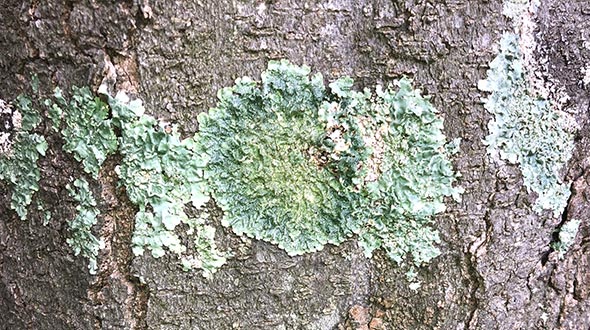
Lichens growing on tree trunk exterior

Lichens do not penetrate tree bark; they attach themselves and spread along the surface. This organism may grow on trees, cement pathways, park benches, brick structures, windows, etc.

Powdery mildew – This fungal disease affects the foliage of various trees and plants. Powdery mildew diseases can be caused by many different fungal species from the order Erysiphales. These fungi appears as a white powdery covering of foliage and stems. It is rarely fatal to mature trees unless widespread infection weakens the tree, allowing subsequent infections and insect infestations.

Powdery mildew growing on tree leaves

Polyporus Alveolaris – This is a species of fungus in the genus Polyporus, and poses a significant risk to trees. It causes white rot in dead and decaying hardwoods. Commonly growing on decaying logs and rotting trees, conks of this species have a yellowish to orange scaly cap and hexagonal or diamond-shaped pores. This species of fungus is widespread across North America.

Ganoderma Applanatum – Rot caused by this fungus may take several years to kill a tree but makes the tree very susceptible to secondary infections, infestations, and wind-throw. The shelf-like fruiting structure forms at or near the soil line. It appears brown to reddish-brown on top with a white-colored margin. The underside of the shelf contains millions of pores in which spores are formed.

Mushrooms on tree trunks ganoderma applanatum fruiting structure

Ganoderma Lucidum – This species causes root rot and forms a shelf-like structure on the wood similar to that of Ganoderma Applanatum. Fruiting structures occur singly or in clusters and have a varnished appearance.

Armillaria – Fungi from this genus cause Armillaria root rot on many species of conifers and hardwoods. The mushroom is a fleshy, firm, honey-colored conk growing in clusters of up to 100 or more. The cap of the mushroom can reach from 1.5 to 6 inches in diameter with a depressed center.

Mushrooms on tree trunks armillaria mellea

Laetiporus Sulfureus – Signs of this fungus include massive clusters of bright, yellow to salmon or bright orange shelf-like conks that turn white with and fall off as they age. The underside of the conk has millions of pores in which spores are formed. These conks appear long after the damage has occurred. Infected trees are prone to wind breakage long before the fungus forms its fruiting structures and should be removed when an infection is confirmed.

Laetiporus sulphureus mushrooms on dying tree trunk

How a Tree Fungus Spreads

Fungi are spread easily from tree to tree by the following means:

Spores – Millions of spores can be produced and released by a single fruiting structure or conk. These spores can be spread by:

• Wind
• Splashing Water
• Rain

Mushroom fruiting structure and spores on tree trunks

Human Activity – Handling diseased plants and trees with gardening tools and pruning equipment, then using those “infected” tools on healthy plants and trees.

Tree Fungus Treatment

The most recommended method of treatment for trees against fungal infections is prevention. By promoting the healthy growth and proper seasonal pruning of your trees, they can resist infections and infestations that can lead to disease.

However, once a fungus infects a tree, the tree cannot be fully cured. Treatments that stop the progression of the disease, allowing the tree to compartmentalize it, can be applied to restore your tree’s health.

Steps you can take to prevent fungal infections include:

• Ensuring proper drainage of the soil around your trees.
• Avoid overwatering your trees.
• Mulch your trees to maintain optimal levels of moisture and ground temperature.
• Apply fungicides like neem oil to tree bark and surface roots.
• Sanitize pruning and gardening tools between trees.
• Fertilize your trees in late winter or early spring as they enter the growing season.
• Have your trees and landscape inspected annually by an arborist.

Sanitized pruning equipment to avoid disease contamination

To avoid widespread infections or catastrophic tree falls, have your trees inspected at the first sign of trouble. The earlier you address fungal infections, the easier it is to treat them.

Tree Fungi and Conks on Trees

When mushroom conks grow on your tree trunk or root flare, there is a grave problem within your tree that must be addressed. Otherwise, a potentially catastrophic tree fall may occur.

In this article, you discovered the signs of fungal tree diseases, types, and identification of fungi, how they propagate and spread, and how to treat them.

Your slow reaction to the signs of fungal infections on your tree may result in the loss of the tree. The tree may eventually fall on your vehicle, home, or causing severe physical injury to people.

Sources:
extension.psu.edu/tree-diseases-that-create-hazards
ipm.ucanr.edu/PMG/PESTNOTES/pn74109.html

Todd’s Marietta Tree Services

200 Cobb Pkwy N Ste 428 Marietta, GA 30062
(678) 505-0266

Originally published on: http://www.toddsmariettatreeservices.com/mushrooms-on-trunk-means-your-tree-dying/

Monday, February 25, 2019

Hickory Tree Facts, Diseases, and Care

Hickory tree in the fall with yellow foliage

Is the lack of information impacting your ability to care for and fight disease on the otherwise resilient hickory tree?

Hickory trees are among the most durable trees native to the United States. Any of the hickory tree species should be considered for your mid-sized or large landscape for their beauty and ease of care.

toddsmariettatreeservices.com gathered hickory tree facts, diseases, care tips, and answers some frequently asked questions.

Hickory Tree Facts

Hickory trees are a member of the Carya genus. There are about twenty species of hickory that comprise the genus, of which, 12 species are native to the United States.

Trees in the Carya genus are blooming and bearing tree species. Hickory trees are tough and durable, among the most long-lived, and are a frequent favorite in Southern landscaping.

Tree Name

Hickory

Scientific Name/Species

Carya tomentosa (most abundant of the hickories)

Family

Juglandaceae (walnut family)

Genus

Carya

Nickname/Other Tree(s)

Bitternut hickory (Carya cordiformis), pignut or black hickory (Carya glabra), sand hickory (Carya palida), red hickory (Carya ovalis), and mockernut hickory (Carya tomentosa) are all species within the Carya genus

State Tree

Texas (pecan – Carya illinoinensis)


Lifespan

Can live up to 500 years or more when planted in optimal conditions

Type

Deciduous

Hardiness Zone(s)

from 4 to 8

Soil Requirements

Tolerates most soil types but in all cases, prefers well-drained soil with full sun exposure

Planting Spacing

20ft between trees

Watering Requirements

Regular (to keep the soil moist) when young or planted. Minimal (during dry spells) thereafter


Height

60 to 100ft

DBH

1 to 2ft at maturity

Crown Span

40ft or more at maturity (the shape may vary depending on the species)

Root Spread

Hickory trees are known for their deep, expansive, and robust root systems which help them from being uprooted during the strongest of winds and storms

Fruit Production

Hickories require a 10-15 year period of growth before they will bear fruit

Uses in Landscaping

Hickories make a magnificent specimen, screen, or large shade tree, and are well suited for more spacious landscapes

Winter/Fall Colors

Golden yellow before leaf-drop in the fall

Hickory Tree Diseases

Hickory trees are extremely tough and resilient to disease when they are healthy, and the following are some of the diseases to watch for:

Hickory Anthracnose/Leaf Spot – The symptoms include large reddish spots on leaf tops and brown spots underneath. When an infection is severe, early defoliation may occur.

Many of the fungi that cause this disease will survive the winter on fallen infected leaves. When these leaves fall, they should be carefully disposed of.

Hickory tree fallen autumn foliage

For more info on the anthracnose disease, visit toddsmariettatreeservices.com/how-to-identify-treat-prevent-anthracnose/

Verticillium Wilt – Symptoms of this infection include entire branches or a whole section of a tree dying off. The foliage on affected parts of the tree will wilt and turn brown.

Help your tree remain healthy by pruning out infected branches, watering during dry weather, and seasonal fertilization.

Powdery Mildew – This disease causes a white “powdery” growth on the leaves. When this disease occurs early in the growing season, it can be treated using the following:

• In one gallon of water, mix one tablespoon of baking soda with a one-half teaspoon of liquid soap (non-detergent).
• Spray liberally on affected foliage.

If this infection occurs late in the season, control will not be required. Make sure that fallen leaves are collected and disposed of.

Witches Broom – This disease will typically follow a leaf spot disease. Symptoms include yellow spots on leaf surfaces with white spots on the underneath side.

Defoliation may occur from severe infections, and when the disease successfully enters the stem, a witches broom will form.

Leaves on the witches broom stems will be small, yellowish, and fall prematurely. When witches brooms form, prune them away, and call a tree service to evaluate the overall health of the tree.

Cankers – Cankers occur when a tree’s bark is wounded, and an opportunistic fungus finds its way into the wound. As the fungus grows and multiplies, it stops the tree from compartmentalizing the wound and can eventually spread throughout the tree.

Cankers that appear on twigs and branches should be pruned out, cutting all the way back to the trunk when the infection is severe. Cankers that form on the trunk of a tree should be inspected by a tree service to determine the best course of action.

To prevent cankers from forming, keep your trees healthy by watering them when the weather is dry, seasonally fertilizing them, and pruning them during their dormancy.

To be best prepared for preventing potential danger, read signs and symptoms of a troubled tree.

Hickory Tree Care

Caring for trees of the hickory species is easy and includes:

• Watering when the weather is dry.
• Pruning during the dormant season.
• Annual fertilizing.
• Treating fungi when affected.
• Scheduling an annual inspection.

Hickory tree watering and care

For more valuable information on tree watering and soil needs, visit toddsmariettatreeservices.com/tree-watering-rich-soil-healthy-trees/

Frequently Asked Questions

Question: Do all hickory trees produce nuts?
Answer: Yes. Hickory trees comprise the genus Carya (Ancient Greek for “nut”).

Question: Are hickory nuts edible for humans?
Answer: Yes. However, the flavor will vary from species to species.

Question: Are Hickory trees related to pecan trees?
Answer: Yes. In fact, the two are so closely related, they grow within the same hardiness zone and require the same care.

Hickory and pecan trees grow in the same hardiness zone and require equal care

Question: How long do hickory trees live?
Answer: Hickory trees are known to live beyond 500 years.

Question: What is hickory wood good for?
Answer: Being one of the strongest and hardest woods native to the United States, hickory is frequently used where shock-resistance and strength are required, such as wood flooring.

Hickory is also popular for smoking cured meats and cooking barbecue.

The Hickory Tree is a Perfect Landscape Specimen

Hickory trees from the Carya genus are easy to care for, and many of the species are native to the United States. These easy trees are among landscapers favorites for their resilience and ease of care.

In this article, you discovered hickory tree facts, diseases, care tips, and uncovered answers to frequently asked questions.

If the hickory tree isn’t a part of your landscape, you are missing out on a slow growing, beautifully shaped shade or screen tree. They are easy to plant and require minimal care efforts.

Sources:
http://hort.ufl.edu/database/documents/pdf/tree_fact_sheets/carovaa.pdf
http://www.bio.brandeis.edu/fieldbio/Survival/Pages/hickory.html
http://nwdistrict.ifas.ufl.edu/hort/2013/10/25/the-hickory-tough-and-durable-landscape-trees/
https://hgic.clemson.edu/factsheet/pecan-planting-fertilization/

https://plus.google.com/+Toddsmariettatreeservices

Todd’s Marietta Tree Services

200 Cobb Pkwy N Ste 428 Marietta, GA 30062
(678) 505-0266

Originally published on: http://www.toddsmariettatreeservices.com/hickory-tree-facts-diseases-care/

Wednesday, December 26, 2018

5 Marietta Ga Tree Diseases – Identification and Treatment

Fallen diseased tree Marietta Ga

That concerning tree in your yard may be diseased and risky to leave unaddressed. However, inaction is what often leads to severe and avoidable damage.

While diseased trees can pose a threat to your landscape, property, and surrounding people, identifying and treating such cases properly can mitigate and prevent disastrous tree fall situations.

toddsmariettatreeservices.com names five common tree diseases in Marietta GA, how to identify, treat, and when to have the tree evaluated by a professional.

Fire Blight Symptoms and Treatment

Fire blight is a disease that flourishes in humid, rainy weather when the average temperature rises to 60 degrees Fahrenheit and above.

Symptoms – As the name implies, symptoms of this disease cause the appearance of fire scorching or burning. When inspecting your tree, look for these signs:

• Infected flowers turn black and die.
• Twigs and stems turn black and curl over.
• Branches appear scorched as their leaves turn black and shrivel up.
• Cankers will appear on branches and the trunk.

Transmission – Fire blight is easily transmitted to other trees, shrubs, and plants by birds, animals, splashing water, and unsterile gardening tools.

Fire blight tree disease transmission in Marietta Ga

Treatment – The following measures should be taken immediately to eliminate and prevent the spread of fire blight:

• Apply a copper fungicide before the flowering season.
• Extensive pruning of all affected areas.
• Take pest control measures to eliminate ants and other insects which may transmit the disease.
• Convert your watering method to drip lines. (Avoid sprinklers or spraying)
• Sanitize gardening equipment with a water and bleach solution after use on infected landscapes.

Call a Professional – When more than 25% of a tree must be removed, seek the advice of a professional tree service or arborist. It may be necessary to remove the tree altogether. Likewise, when multiple trees, shrubs, and plants are infected, a professional can help you devise a plan to halt the disease.

Powdery Mildew Symptoms and Treatment

Much like fire blight, powdery mildew thrives in the springtime when temperatures range from 60 to 80 degrees Fahrenheit. There are several fungi which can produce powdery mildew.

Symptoms – As the name suggests, powdery mildew can appear on any part of its host and resembles white or slightly off-white mildew. Numerous spores begin to emerge as the fungi mature.

Transmission – Insects such as aphids are the principal means of transmission. However, when spores are released, splashing water or wind may spread the fungi.

Powdery mildew tree disease transmission in Marietta Georgia

Treatment – The following measures will help you control and eliminate powdery mildew from your landscape:

• Apply non-chemical organic fungicides such as milk, bicarbonates, and oil. An effective solution is diluted at 1 part fungicide to 10 parts water. This fungicidal mix produces outstanding results when used for preventative measures or sprayed directly on the infected plant.
• Applying a neem oil solution disrupts the fungus’ metabolism – preventing spore production.

Call a Professional – When topical treatment can’t stop powdery mildew, or when it eliminates powdery mildew, but your tree’s health continues to decline, there may be another pathogen or insect at work. Request an inspection and evaluation from a tree care professional.

Anthracnose Symptoms and Treatment

Anthracnose thrives in the springtime with prolonged periods of rainfall and when temperatures are consistently mild.

Symptoms – The symptoms of anthracnose include the following:

• Bud and twig death
• Dead spots on leaves
• Dead tissue or blotches along and between leaf veins
• Unseasonal or premature leaf-drop
• Lesions known as cankers in tree bark (open wounds)
• Dark colored pimple-like fruiting structures (acervuli) on the underside of leaves.

Anthracnose disease infected tree in Marietta Ga

Transmission – Similar to fire blight, anthracnose is easily transmitted to other trees, shrubs, and plants by wildlife, splashing water, rain, and unsterile gardening tools.

Anthracnose fungi (there are several fungi which can cause anthracnose) can survive the winter months in fallen leaves, or in cankers formed in the bark of branches or the trunk.

Treatment – The following measures should be taken immediately to eliminate and prevent the spread of anthracnose:

• Extensive pruning of all affected parts.
• Utilize a fire pit or bonfire to destroy affected clippings and foliage.
• Convert your watering systems to drip lines. (Avoid sprinklers or spraying)
• Sanitize gardening equipment with a water and bleach solution after use on infected landscapes.

Read the following article for more on How to Identify, Treat, and Prevent Anthracnose.

Call a Professional – When 25% or more of a tree must be removed, seek the advice and assistance of an arborist or reputable tree service.

It may be necessary to remove the tree altogether. Without treating anthracnose, you will be leaving your tree susceptible to other infections and infestations.

Root Rot Symptoms and Treatment

Changes in landscaping, soil compaction, soil composition, or persistent rains may cause root rot.

Symptoms – Severe and fast branch die-back, premature color change of the leaves, widespread leaf spots, sap coming from the bark, and mushrooms around the root flare may all indicate root rot.

Transmission – Root rot is typically the result of poor drainage or changes in the soil composition and texture. This either kills the roots or allows access to pathogens, which weakens and eventually kills them.

Treatment – If your tree is diagnosed with root rot, the recommended treatment is to have the tree removed.

Diseased tree dying from root rot in Marietta Georgia

To prevent further cases of root rot, ensure that the soil in your landscape is well-drained, and that roots are protected from soil compaction.

Call a Professional – If you suspect that a tree is suffering and dying from root rot, call a professional to have the tree evaluated immediately. Depending on the size of the tree and the amount of damage to the roots, the tree may fall at any time.

Heart Rot Symptoms and Treatment

When a fungal disease causes the softening and decay of the wood found at the center of a tree’s trunk and branches, this is known as heart rot.

The softening of the heartwood leaves a tree vulnerable to the pressure of its own weight and prone to collapse.

Symptoms – A reliable indicator that heart rot is present within a tree is the presence of fungus conks or mushrooms growing from the tree’s trunk or branches.

Transmission – Heart rot is able to attack the heartwood of a tree through damaged bark or improper pruning.

Tree dying from heart rot disease in Marietta Ga

Treatment – Control of heart rot is achieved by:

• Maintaining your trees healthy and vigorous.
• Using proper pruning techniques.
• Having the trees inspected by an arborist annually.
• Providing post-storm care and maintenance.

Heart rot affects trees across the world. When trees are healthy, they are able to isolate and stop this disease through a process called compartmentalization.

Call a Professional – If you suspect that your tree is suffering from heart rot, do not hesitate to call a professional tree service to evaluate the tree and recommend a course of action. Act promptly, as trees that suffer from this disease can cause catastrophic damages when they collapse unexpectedly.

Tree Disease and Landscape Health

Because diseased trees are susceptible to fall at any time, it is imperative to be educated and swift in taking action to treat these disease cases.

Discovering how to identify and treat the diseases that are common in Marietta Georgia is a great start.

Being informed and giving more attention to your trees may seem like extra effort, but sleeping well at night knowing your property and people are safe is worth the energy.

Sources:
http://extension.uga.edu/publications/detail.html?number=B1238&title=Common%20Landscape%20Diseases%20in%20Georgia
http://www.gfc.state.ga.us/community-forests/management/tree-care/insects-and-diseases/index.cfm

https://plus.google.com/+Toddsmariettatreeservices

Todd’s Marietta Tree Services

200 Cobb Pkwy N Ste 428 Marietta, GA 30062
(678) 505-0266

Originally published on: http://www.toddsmariettatreeservices.com/5-marietta-ga-tree-diseases-identification-treatment/