Showing posts with label Leaning Tree. Show all posts

Tuesday, February 25, 2020

How To Identify and Manage 7 Deadly Tree Defects

Cracked branches or tree trunks are defects that can lead to sudden toppling destruction and injury

If you don’t know what to look for, a tree defect can cause a significant hazard for you. By knowing how to identify and manage severe tree defects, you can prevent catastrophic and life-threatening damages from branch and tree falls.

toddsmariettatreeservices.com gathered information on 7 tree defects, how to identify them, and how to manage them before they become deadly.

Deadly Tree Defects

The following tree defects are structural in nature and can result from disease, poor tree architecture, or injury. When such defects cause a tree or branch to fail, the damages or injuries to structures and people can be utterly catastrophic.

Here’s how to identify and manage these deadly defects:

Cracks in Branches or Tree Trunks

Cracks in your tree can represent weakness in the tree’s structure or internal decay rotting away at the inner wood of the tree.

How To Identify Cracks – When you can see past the bark of the tree into the lighter colored inner wood, you have identified a crack. Cracks can follow the grain of the tree (as if the tree was splitting) or intersect it (as if the tree was breaking), both types of breaks require your immediate attention.

How To Manage Cracks – If the crack is located on a branch away from the branch collar, it can be pruned off the tree at the root collar. However, if the crack is located on the tree trunk, you may have to have the tree removed to eliminate the danger it poses.

When it comes to cracks on a tree, it is highly recommended to call a professional tree service to perform a hazard assessment and offer a reasonable course of action. Read more about tree hazard assessments at toddsmariettatreeservices.com/why-do-i-need-tree-hazard-assessment/

Weak Branch Unions

Some branches on trees may grow in a way that makes them a severe hazard as the tree grows larger and heavier.

How To Identify Weak Branch Unions – Look at the area where the branch meets the tree trunk. There “should” be what is known as a branch collar or branch bark ridge (strong attachment). If this branch collar is absent, this is known as included bark in the branch attachment (weak attachment).

A weak branch union is tree defect that can lead to sudden falling

How To Manage Weak Branch Unions – Prune out branches with weak connections to the tree trunk. As the tree and branches grow, so shall their weight. When these branches spontaneously detach from the tree, they can wreak havoc on lower branches, and whatever else is below.

Read more about tree pruning and cutting at toddsmariettatreeservices.com/right-time-cutting-pruning-emergency-tree-removal/

Poor Tree or Crown Architecture

Poorly-maintained or unmaintained trees can present several worrisome defects. Perhaps the most troubling of those defects is the growth of multiple leaders. Multiple leaders are the vertical branches of a tree from which the horizontal branches form the crown.

How To Identify Poor Tree Architecture – Stand far enough away from the tree in question, so that you can see the majority of the crown and the branches that lead into it from the trunk. If the tree looks lopsided (more branches and foliage on one side of the crown), or there are multiple leaders, the tree’s architecture should be addressed.

The lower on the trunk that multiple leaders begin, the more unstable the tree will be as it grows.

Multiple leaders are a tree defect that can lead to weak stems and collapse

How To Manage Poor Tree Architecture – For trees with a disproportionate crown, a professional tree service should be hired to thin the crown and restore a sense of balance to the tree.

For trees growing multiple leaders, especially those trees growing them low to the ground, one leader should be chosen to remain while the others are pruned from the tree. This type of management is most effective when the tree is younger.

Leaning Trees

Trees that lean can have an ominous appearance. If that lean is greater than 15 degrees, removal of the tree should be considered for damage and injury prevention. When it comes to the direction of a fall, avoid basing your assumption on the direction of the lean, wind and holding wood can cause it to fall in any direction, including opposite the direction of the lean.

How To Identify A Corrected Lean – A corrected lean happens when a tree has been leaning for a very long time. The base of the tree will lean, but the trunk corrects itself as the tree grows. This may appear as a curvature or a hard angle (crook) where the tree corrected itself.

As the tree ages, a natural lean may slowly increase due to the increasing weight of the trunk and crown.

How To Manage A Corrected Lean – Corrected leans are relatively common in nature and don’t require immediate attention. However, if it becomes an uncorrected lean, the tree may have to be removed.

How To Identify An Uncorrected Lean – These leans can occur when the root plate destabilizes, cracks on the trunk increase in size, or decay at the top or bottom of the trunk cause the crown or entire tree to lean.

An uncorrected lean is a tree defect that can lead to toppling injury and damage

How To Manage An Uncorrected Lean – Trees with an uncorrected lean are extremely hazardous and have already begun to fall. These trees should be addressed and removed by a professional tree service immediately.

Tree Decay

Tree decay is one of the most common contributors to tree failure during severe weather events, and in advanced cases, sudden tree failure.

How To Identify Tree Decay – When fungal fruiting structures or mushroom conks begin to bloom out of the trunk or root flare, there is decay at work deep within the tree. This is an incredibly dangerous situation that should never be overlooked or ignored.

Fungal infection ia a tree defect that can lead to severe decay poor health and eventual death

How To Manage Tree Decay – Once you have identified the signs of decay, have a tree risk assessment performed as quickly as possible to determine when the tree should be removed.

Tree Root Problems

While tree roots may be buried, their effect on trees becomes very evident, making identification fairly easy.

How To Identify Tree Root Problems – Two common root problems can lead to the failure and falling of a tree. One problem is stem girdling roots (SGRs), these roots encircle the tree trunk just under the ground. As the tree grows, the encircled roots also grow and thicken. The SGRs eventually cause the complete hydraulic failure of the tree.

Look at the root flare, if you see one of the flares making a hard turn “hugging” the curvature of the trunk, it is likely encircling the trunk. Another sign is the sudden wilting and death of the entire crown of an otherwise healthy tree.

Stem girdling roots are a tree defect that can lead to poor health and death

Root rot can be caused by any one of several disease pathogens. It can also occur in soaked soil with poor drainage. When root rot is present, you may see an entire section of the tree’s crown wilt and die. In severe cases, where the entire root plate is affected, the whole crown may suddenly wilt and die.

How To Manage Tree Root Problems – For SGRs, these roots must be cut away from the tree before killing it. For root rot, upon detection, a professional tree service should be called to assess the severity of the damage and whether or not the tree can be salvaged.

Tree Trunk Cankers

Cankers can appear on and affect tree trunks and branches. They are areas of tissue that have been killed by fire, sunscald, disease, insects, animal, and/or human activity.

How To Identify Cankers – Cankers appear as a darkened or sunken area of bark. This affliction causes an area of previously living bark to die and is usually associated with decay. Some cankers will ooze sap or fluids produced from the decaying of sapwood.

Cankers are a tree defect that can lead to infection rot and death of the host

How To Manage Cankers – Cankers on branches should be pruned off the tree when discovered. This prevents any disease or pathogen from spreading further within the tree. Cankers on the trunk are more problematic and should be treated the same as a crack.

Cankers on tree trunks weaken the structure of the tree and are highly susceptible to insect infestation and disease. It is highly recommended that a professional tree service be called to perform a tree hazard assessment and recommend preventative measures.

Managing Tree Defects

In this article, you discovered 7 deadly tree defects, how to identify them, and what actions to take before they cause catastrophic loss and/or injury.

By taking immediate action to reverse or eliminate tree defects, you are ensuring the safety of your property and eliminating a potentially deadly tree failure.

Ignoring the signs of tree defects can result in costly damages to your property, structures, and vehicles. If the defect is coupled with a disease or infestation, your failure to respond may spread such problems to other trees and plant life on your property.

Sources:
forestpathology.org/hazard-trees/hazard-tree-defects/
in.gov/dnr/forestry/files/04_Identify_and_Manage.pdf
archive.lib.msu.edu/tic/holen/article/2013mar16.pdf
forestryimages.org/browse/Bareas.cfm?domain=23

Todd’s Marietta Tree Services

200 Cobb Pkwy N Ste 428 Marietta, GA 30062
(678) 505-0266

Originally published on: http://www.toddsmariettatreeservices.com/how-to-identify-manage-tree-defects/

Monday, September 23, 2019

How to Stake a Leaning Tree

Staking young trees to avoid weather damage

Your leaning tree can fall, causing catastrophic and life-threatening damages. By staking your tree, you can help it re-establish itself, prevent its death, and eliminate the danger of it falling.

toddsmariettatreeservices.com gathered information on why trees lean, how to properly stake them, and when tree removal may be necessary.

Why Trees Lean

Before taking action to stake or brace a tree, it’s helpful to understand the reasons why trees may lean in different stages of their growth.

The following require staking, bracing, or cabling and can be halted or reversed:

• The tree was planted off-center.
• The tree may be leaning towards the sun.
• The root ball has shifted in unsteady soil.
• Constant wind has shaped the tree to curve or has moved its center of gravity.
• The tree was struck by a vehicle or heavy machinery.
• Neighboring support trees were removed.
• The crown is off-center from poor pruning practices.

The following are irreversible and may require the immediate removal of the tree:

• An earthquake, floodwater, rockslide, or landslide has caused the root plate to destabilize and fail.
• Roots are failing due to rot from disease or poorly-drained soil.
• The tree trunk cracked.

As trees reach maturity, they can weigh from 2,000 to 20,000 pounds. When that weight becomes off-centered, and the tree begins to lean, quick action is required to prevent a fall with potentially deadly results.

Tree bracing and support for uneven crown or leaning tree

Read How to Identify a Tree Emergency, and if you have a mature tree threatening to fall, call a tree professional to evaluate the immediate risk and lay out a course of action.

Tree Support Systems to Prevent or Stop Their Leaning

Support systems for young and leaning trees change as trees mature. The following are different systems used at various stages of tree development:

Planted as a Seedling – For the first 6 months to one year, the tree should be protected from the elements and wildlife by a chickenwire encircling enclosure, lined with burlap on the upwind side.

Transplanted Trees – Bare root and rootball transplants are highly susceptible to the elements until their root system extends and forms a firm root plate. These trees should be staked for 1 to 2 years while this process takes place.

Young trees planted as seedlings should be staked once they outgrow their protective enclosures to prevent leaning or severe weather damage.

To accomplish this:

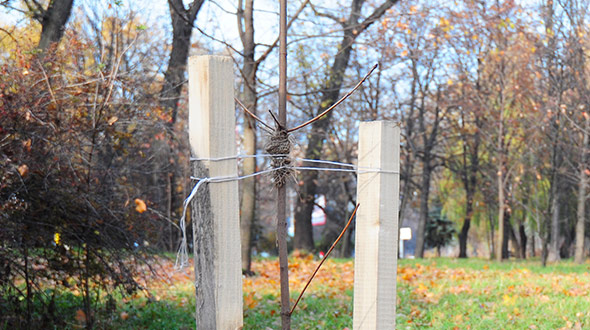
1. Drive two 8 foot stakes 2 feet into the ground on either side of the tree trunk (about 1 1/2 feet from the trunk on each side).
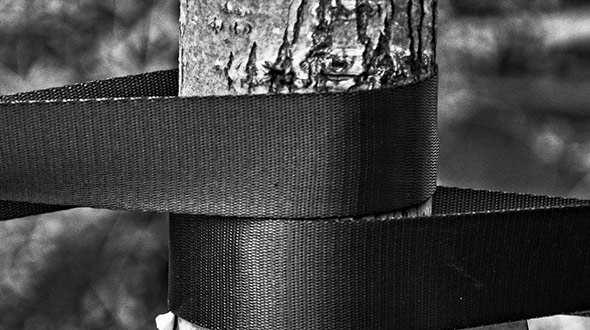
2. Tie or attach a piece of burlap or other soft material – looped around the trunk – to each of the stakes. There should be enough slack for the tree to sway 3 to 6 inches in all directions before the material tightens around the trunk.
3. If wildlife is an issue, surround the tree with chicken wire using the stakes as a harness.
4. While a tree is staked, check the bark where any contact is made frequently. If damage or wear is detected, move the material up or down on the stakes.

Tree stake tether with slack for natural trunk movement

Never tie or attach anything to trees being staked. Besides bark damage, the tree could end up girdled or sawed through if there is constant friction.

This staking method is highly effective until the trunk reaches a diameter at breast height (DBH) of 4.5 to 6 inches, at which point stronger measures are required.

Trees with a DBH >6 inches – When trees reach this size, they are heavy enough to cause severe to catastrophic damage if brought down during a storm or fall from their own weight. If they begin to lean, take the following actions immediately:

Leaning tree crown thinning to establish center of gravity

• Prune the tree to reset its balance or center of gravity.
• Cabling the tree can relieve pressure from branches, causing a redistribution of weight and stress within the crown.
• Anchor the tree to stop or reverse the lean by:

1. Driving a 5-foot heavy-duty iron stake into the ground 8 to 10 feet opposite the direction of the lean (this stake will be supporting tremendous weight).
2. Attach a cable rated for 1,400 to 1,960 pounds to the stake equipped with a turnbuckle or winching device, and loop the other end around the tree trunk above the first branches.
3. Use foam or rubber as a cushion to prevent the cable from directly contacting the tree’s bark.
4. Tighten the turnbuckle until the cable is firm. Then further tighten the cable every other day.
5. This process can last weeks and be successful provided there are no underlying issues with root rot or disease.
6. Call a professional to evaluate the state of the tree and offer guidance.

In all of the above situations, a tree professional should be called to evaluate the tree, determine why it is leaning, and what actions to take.

Staking Leaning Trees

Trees lean for different reasons, but there are various support systems to be used at different stages of the development of a tree.

In this article, you discovered why trees lean, how to stake or secure them properly, and when tree removal becomes necessary.

When your tree begins to lean, it is telling you something is wrong. Don’t procrastinate and allow a leaning tree to fall on your home or loved ones.

Sources:
gatrees.org/community-forests/ask-the-arborist/LeaningTrees-Whatsupwiththat.pdf
hort.ifas.ufl.edu/woody/cabling.shtml

Todd’s Marietta Tree Services

200 Cobb Pkwy N Ste 428 Marietta, GA 30062
(678) 505-0266

Originally published on: http://www.toddsmariettatreeservices.com/how-to-stake-leaning-tree/

Monday, March 25, 2019

My Tree is Dying – What Do I Do?

Tree death from disease and infestation

Don’t let your dying tree fall on your house. All trees grow, age, and will eventually die, knowing the signs of a troubled tree and how to respond will keep your property and loved ones safe.

Illness and disease can slowly eat away at the health of your trees, and when this happens, knowing what to do becomes critical. In some cases, the signs are so subtle that trouble is overlooked, and the tree subsequently falls on your car or house.

toddsmariettatreeservices.com explains how to identify a tree emergency, the signs of a troubled tree, and what to do when your tree starts dying.

Dying Tree Emergency

There are tree emergencies that are obvious and require immediate attention. The following situations will generally end up requiring an emergency tree removal:

Leaning Tree – When a tree can no longer secure itself to the land it is growing in or has broken away from the roots holding it down, it may lean before falling. This is a tree emergency and may require its immediate removal by a professional tree service.

Leaning tree indicates potential health emergency

Mushrooms Growing on the Tree – One of the most alarming signs that a tree is dying is the growth of mushrooms on the trunk.

Mushrooms require decaying organic material to flourish. If they are growing on your tree, it means that the inside of the tree is decaying and is an immediate hazard to its surroundings.

Dying tree with mushrooms on the trunk and roots

As with the situation of a leaning tree, this is an emergency requiring immediate professional action.

Insect Infestation – Boring insects can wreak havoc on the inside of a tree. If severe enough, an infestation can kill stressed or healthy trees, and continue to spread from tree to tree.

If you have detected the presence of boring insects, it is imperative that a professional tree service is called to evaluate the extent of the infestation, the amount of damage your tree has sustained, and a plan to halt the spread of the infestation to neighboring trees.

Termite and boring insect infestation kills trees

To learn more about the signs and symptoms of a troubled tree, read toddsmariettatreeservices.com/troubled-tree-signs-symptoms/

My Tree is Dying – I Think

As trees grow, they go through many phases which may appear as if they are dying. That’s not always the case. Take the following into consideration:

Deciduous Trees – At the beginning of fall, you may notice your tree’s green leaves turning shades of red, orange, and yellow. Within a couple of weeks, all of the leaves fall to the ground leaving the trunk, branches, and twigs bare.

Healthy deciduous tree with fall colored foliage

In this scenario, your tree is likely doing what it needs to do in preparation for dormancy. Dormancy may cause your tree to appear dead, but in reality, this process is its protection against freezing temperatures and severe winter weather.

If however your tree loses its foliage before the fall season, or shows no sign of life into late spring, have the tree evaluated by a professional to determine a course of action.

Falling Branches – Without warning, an entire branch comes crashing to the ground. While this may be an alarming event, there are tree species such as the eucalyptus, Carolina poplar, American elm, aspen, or pecan tree that will drop a branch unannounced.

Dying tree self pruning by dropping entire branches

These trees are considered self-pruning. They are shade intolerant, and when the leaves of a branch don’t get enough sunlight to provide sufficient photosynthesis, the tree may simply dispatch the entire branch. Read northernwoodlands.org/articles/article/woods-whys-self-pruning-branches for more on self-pruning branches.

Before using the branch for firewood or disposing of it, inspect it for signs of infection or infestation. When a tree species that is not self-pruning drops a branch, it is an indication that something serious may be occurring within the tree.

In the absence of disease or infestation, professional crown thinning and seasonal pruning will help your tree avoid self-pruning.

Discover the right time for cutting, pruning, and emergency tree removal at toddsmariettatreeservices.com/right-time-cutting-pruning-emergency-tree-removal/

How to Handle a Dying Tree

While trees add value to their surroundings, benefit the environment, and are naturally beautiful, they can become a deadly liability as they age, become ill, and eventually die. Knowing how to identify and handle the signs of a dead or dying may save your property and the well-being of your loved ones.

In this article, you discovered what a tree emergency looks like, the signs of a troubled tree, and what to do if your tree is dying or dead.

Once you have detected a tree problem, you must take action to treat or remove that tree before it falls and causes catastrophic property damage or physical injury.

Sources:
https://www.jstor.org/stable/40595781?seq=1#metadata_info_tab_contents
http://extension.uga.edu/publications/detail.html?number=C1100&title=Is%20My%20Tree%20Dying?
https://extension.umd.edu/hgic/topics/how-do-you-decide-when-remove-tree

https://plus.google.com/+Toddsmariettatreeservices

Todd’s Marietta Tree Services

200 Cobb Pkwy N Ste 428 Marietta, GA 30062
(678) 505-0266

Originally published on: http://www.toddsmariettatreeservices.com/my-tree-is-dying-what-do-i-do/