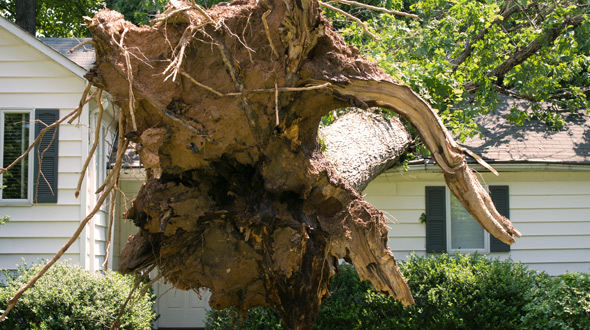
Killing tree roots, removing them, and cutting them are three ways to control the growth of roots, and the damage they can cause to driveways, retainer walls, and home foundations.
Each of these actions has the potential to solve your principle problem, while creating another one. In this article, we will discuss each option and how it affects your tree and landscape. We will also provide several alternatives which could potentially solve your root problems.
Identifying Your Root Problem
In their constant quest for moisture and nutrients, roots will grow in some inconvenient places. Depending on soil compaction and quality, they will adapt and change growth behavior. The following are common scenarios of root damage and undesired growth:
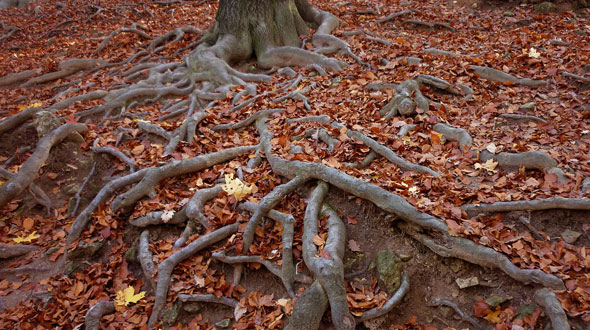
Roots Growing on Ground Surface – As tree roots mature and as natural soil erosion or compaction occurs, the roots may become exposed along the ground.
Roots Growing Under Foundation – When roots grow under a home’s foundation, they will thicken as they age and continue to grow. This growth exerts an upward force on the foundation, partially raising it, bending, or warping it until it cracks.
In the event you are dealing with a mature tree planted too close to your home, this page offers further insight into resolving your problem.
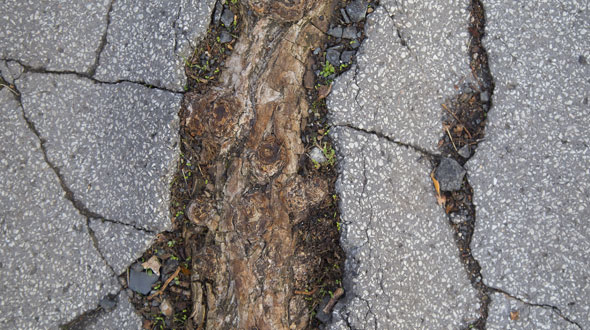
Roots Buckling and Cracking Sidewalks and Driveways – The way roots grow under and damage a structure’s foundation, they can efficiently do the same to a concrete driveway or sidewalk.
The Tree Root System
Whether surface roots or underground destructive roots are the issue, take a moment to learn the importance of the roots in relation to the tree’s health before killing, removing, or cutting them.
- More than 25% of a mature trees’ mass is found in its root system.
- The majority of those roots remain from 6 to 18in below ground surface.
- Injured roots are susceptible to disease or infestation. This directly impacts the health of the tree, potentially leading to its decline and eventual death.
The two types of roots found below ground are:
- Feeder Roots – which transfer and store moisture and nutrients from the soil.
- Structural Roots – which stabilize or anchor the tree to the ground (these are the larger of the roots)
Killing Tree Roots
Option 1: Cut Down the Tree

“Once a tree has been cut down, roots can no longer grow.” The idea here is that they are dependent on the leaves photosynthesizing the fuel that drives their growth. Two potential exceptions to this are:
Tree Sprouts (Suckers) – These look like seedlings or offspring but are “clones” of the tree growing from the roots. With enough foliage, the roots may survive.
Neighboring Tree Association – There is evidence that shows the possibility of neighboring tree roots making associations with each other. This occurs through root grafting as they run into one another. This association has the potential to sustain the felled tree’s roots for continued growth.
Option 2: Use Herbicides
A very effective way to kill more of the root system (than simply cutting down the tree) is through the use of herbicides. The following video demonstrates an effective herbicide delivery method.
In the summer or early fall, when the tree still has leaves producing food, cut notches around the lower portion of the tree trunk. You only need to cut deep enough to reach the phloem (phloem is the tissue responsible for transporting food to the roots).
Apply the herbicide to the notches and allow two to three weeks before having the tree removed.
This type of herbicide can be found at your local gardening store and will come labeled specifically for this purpose. As with any chemical, be sure to read and follow all use and safety instructions.
Killing roots through the use of herbicides may cause serious collateral damage to neighboring trees. If their root systems have made associations with each other. The herbicide could potentially travel from one tree to another resulting in the decline or death of the other (otherwise healthy) tree.

If there are several trees in your yard or landscape, have them evaluated by a tree service professional before using herbicides in this manner.
Tree Root Removal – How to Safely Do It
There are two principle lines of thought for root removal:
Tree Has Been Removed – In this scenario, after the stump has been removed or ground down, simply follow the path of the roots. Dig them out and cut into sections (for larger roots).

Removing Disruptive or Damaging Roots – In this scenario, you do not want to lose the tree. Only the roots that are either growing on the ground surface or interfering with a foundation, retainer wall, or other structure.
This video shows how tree roots interact with a barrier like a retaining wall.
Once you have selected the roots to be removed, the following steps will help you safely and efficiently get the job done. See also “Cutting Tree Roots – Planning” below for further tips and advice.
Tools – The tools you will need to safely do this job include but are not limited to:
- Spray Paint
- Shovel
- Spade
- Sharp Hand Saw
- Cloth
- Alcohol
- Soil
- Mulch
- Seed
Mark Your Cuts – Using spray paint, mark protruding roots to be cut or spray the ground where you intend to dig to the roots.
Clear The Surface – Using the shovel, carefully dig around the area of the root where it will be cut. You will need enough space to safely work with a saw.
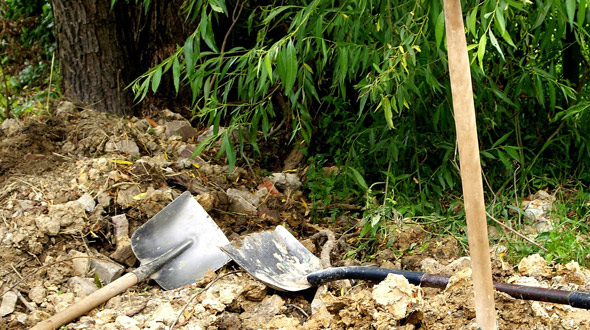
Remove Soil Around Root – Using your spade, remove the soil from the sides and from underneath the root. Again, leaving enough space to safely use your saw.
Sterilize the Saw – (for live roots) As open or wounded roots are highly susceptible to disease, you can minimize exposure by sterilizing the saw with an alcohol drenched cloth.
Make the Cut – Saw through the root just below a secondary or side root growing downward.
Finish the Job – Once the root is cut, pull up the remainder of the cut root. (for live roots) Quickly replace the soil around the remaining root. Fill in any holes with soil and reseed the area if needed. Water the tree well within the dripline (under the canopy).
Mulch – When all is done, spread a loose 2-3 inch layer of mulch over all of the root area in the dripline.
Cutting Tree Roots – Planning and Execution
Properly cutting tree roots can help achieve a deeper, stronger, and healthier root system.
Also known as Root Pruning, this process should never be approached without a plan. We advise hiring a professional tree service, but the following will educate and help you to understand the process and goal:
Leaning Trees – Stop here. Do not cut the roots of a leaning tree. In this case, you will need to call a tree professional to assess the safety of the tree and which roots (if any) may be cut.
Season – Unless the situation is absolutely necessary, tree root pruning should only be done in late winter or early spring when the tree’s functions are still slow. This is the time of year that the risk of dehydration is at a minimum, thus less risk of damaging your tree.
Distance – When dealing with a mature tree, measure the DBH (Diameter at Breast Height). You will want to avoid cutting any roots within a distance of 5 times the DBH from the tree trunk.
For example, if the DBH is 12 inches, you will only want to make cuts to roots that are outside of a 60 inch radius from the tree’s trunk.
Younger Trees – Young trees have a better chance of recovering from root pruning and can be pruned closer to the trunk (3 times the DBH). However, in any situation, the farther away from the trunk you can get, the better and safer it will be.
Cut In Quadrants – Never remove more than 25% of a tree’s roots at one time. Divide the area around the tree into four quadrants and carefully cut roots in 2 quadrants opposite each other. After 2 years, it should be safe to cut the roots in the remaining 2 quadrants.
Avoid the Largest Roots – The larger roots are structural roots, they are the ones that begin at the base of the tree and flare out. These are the ones keeping the tree anchored in its place. If one of these roots is to be removed, make sure the cut is made as far from the trunk as possible.
When a cut to one of these roots needs to be made closer to the trunk, a tree professional should be called to assess the potential effect on the stability of the tree.
Mark Your Cuts – Using spray paint, mark protruding roots to be cut or spray the ground where you intend to dig to the roots.
Cut Below Secondary Roots – Your cuts should be made below a secondary (or side) root growing downward. This will not only improve the chances that it will continue nourishing the tree, it will likely guide root growth into deeper soil.
Finish the Job – Once the root is cut, pull up the remainder of the cut root. Then quickly replace the soil around the remaining root. Fill in any holes with soil and reseed the area if needed. Water the tree well within the dripline (under the canopy).
Mulch – Once finished, spread a loose 2-3 inch layer of mulch over all of the root area in the dripline.
Root Cutting and Removal Without Killing Your Tree
Root cutting and removal can indeed be accomplished without crippling or killing your tree. It is a process that must be precise and taken slowly to preserve the integrity of the tree. Keep the following in mind:
Poor Pruning – A bad prune job in the crown or in the roots can severely compromise the health of a tree, eventually leading to its death.
Trunk Proximity – The closer to the trunk that roots are cut, the more significant and severe the damage will be to your tree.
25% Rule – Never remove more than 25% of a tree’s roots. The tree will likely die or fall, or both.
2 Years – A tree should be given two years to recover between root pruning.
Spring Time – After bud break, tree roots should not be pruned. This is the time your tree is most reliant on them.
Alternatives to Root Cutting, Killing, and Removal
The idea of cutting your tree roots may seem less appealing now. If you find that the risk of losing your tree is too great, here are some potential alternatives:
- Add soil over the roots that have surfaced and reseed.
- Design your landscape around the tree root spread.
- In hardscapes, use reinforced cement.
- Install root barricades.
- Replace a broken or buckled cement walkway or driveway with a gravel one.
- When planting new trees, make sure the soil is appropriate for the species and water it well for deep root growth. Click here for more on watering and soil.
The following video demonstrates how root barricades are installed.
Regardless of the solution, Look after the health of your tree! And when in doubt, call a professional to evaluate and assess what actions should or should not be taken.
Source(s):
http://aces.nmsu.edu/ces/yard/2000/030400.html
http://homeguides.sfgate.com/dangers-cutting-tree-roots-40686.html
http://hort.ufl.edu/woody/root-prune-guidelines.shtml
http://hort.ufl.edu/woody/urban-sidewalk.shtml
http://m.visitmadison.org/site/v/default?url=http%3A%2F%2Fwww.wikihow.com%2FDig-up-Tree-Roots#2861
https://plus.google.com/+Toddsmariettatreeservices
Todd’s Marietta Tree Services
(678) 505-0266